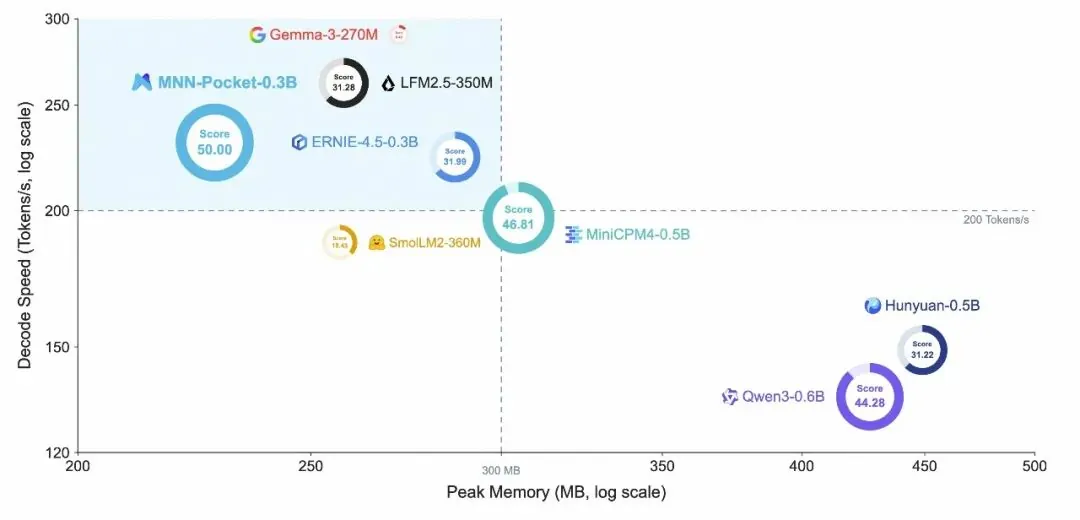
MNN-Pocket-0.3B 모델 공개
IT之家 11월 6일 소식에 따르면, Taobao 산하 MNN 팀이 오늘 MNN-Pocket-0.3B 모델을 공개했습니다. 이 모델은 휴대폰 애플리케이션의 작업 요구사항과 리소스 예산을 고려하여 제한된 컴퓨팅 성능, 메모리 및 에너지 소비 내에서 작업 능력, 응답 속도 및 지속적인 실행 경험을 모두 충족하도록 설계되었습니다.
Taobao와 같은 종합 휴대폰 애플리케이션을 중심으로, 팀은 "휴대폰 애플리케이션 네이티브 대규모 모델"을 네 가지 설계 목표로 구체화했습니다.
- 속도: 지정된 장치 및 컨텍스트 구성에서 디코딩 처리량이 200token/s를 초과합니다. 이 목표는 고속 클라우드 모델 서비스의 생성 처리량을 참고하여 로컬에서 원활한 생성 경험을 제공하는 것을 목표로 합니다.
- 메모리: 지정된 테스트 조건에서 피크 메모리가 300MB 미만입니다. 휴대폰이 8~16GB 메모리를 가지고 있더라도 시스템과 여러 애플리케이션이 공유해야 합니다. 약 500MB의 모델 모듈 예산을 예로 들면, 추론 피크를 300MB 미만으로 제어하여 컨텍스트 증가 및 통합 오버헤드에 대한 여유 공간을 확보할 수 있습니다.
- 전력 소비: 일반적인 추론 부하(입력 512~1024token, 출력 128token)에서 단일 추론 증분 에너지 소비 목표는 참조 휴대폰 배터리 에너지의 만분의 일, 즉 100회 추론 에너지 소비가 배터리 총 에너지의 1%를 초과하지 않도록 하여 고빈도 호출의 배터리 수명 오버헤드를 제어합니다.
- 능력: 지정된 비즈니스 시나리오에서 8B급 모델의 효과를 달성하는 것을 목표로 하며, 중영문 이해, 세계 지식, 수학, 코드 추론 능력을 모두 고려하고, 명령 준수를 중점적으로 강화하며, 긴 컨텍스트 및 다단계 작업을 위한 확장 공간을 확보합니다.
MNN 팀은 약 3억 개의 매개변수를 가진 이 경량 언어 모델을 처음부터 설계하고 훈련했으며, 중국어와 영어를 중점적으로 지원합니다. 모델 구조, 어휘, 훈련 데이터, 사전 훈련 및 사후 훈련 방법, 양자화 및 추론 엔진을 협력적으로 최적화하여 Taobao 비즈니스 및 오픈소스 커뮤니티 개발자에게 작업 이해 능력, 빠른 응답, 쉬운 적응 및 통합이 가능한 모델 기반을 제공합니다.
성능
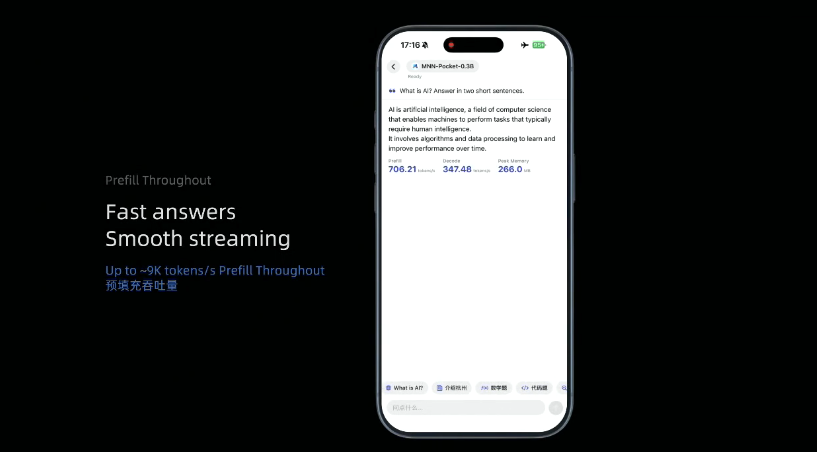
- MNN-Pocket-0.3B는 Apple iPhone 18 Pro에서 실제 테스트 결과, MNN 추론 엔진을 통해 완전히 오프라인으로 실행되며 평균 디코딩(Decode) 속도는 약 350token/s입니다.
- MNN-Pocket-0.3B의 INT4 MNN 배포 파일 크기는 173MB에 불과하며, 모델 가중치, 토크나이저, 계산 그래프 및 추론 구성을 포함합니다.
- iPad Pro M5, Metal 백엔드, 512token 테스트 구성에서 모델 로드 및 추론 중 피크 Metal 상주 메모리는 로드 전 기준선 대비 228MB 증가했습니다.
- 동일한 테스트에서 Qwen3-0.6B의 배포 파일 크기는 340MB, 피크 메모리 증가는 427MB였습니다. 이에 비해 MNN-Pocket-0.3B의 배포 크기는 약 49% 감소했고, 피크 메모리 증가는 약 47% 감소했습니다.
휴대폰 애플리케이션 네이티브 대규모 모델의 경우, 작은 배포 크기는 모델 다운로드 및 업데이트 비용을 절감할 수 있으며, 낮은 실행 메모리는 페이지, 이미지, 비디오 등 비즈니스 모듈에 더 많은 공간을 확보하여 애플리케이션 통합의 리소스 부담을 줄입니다.
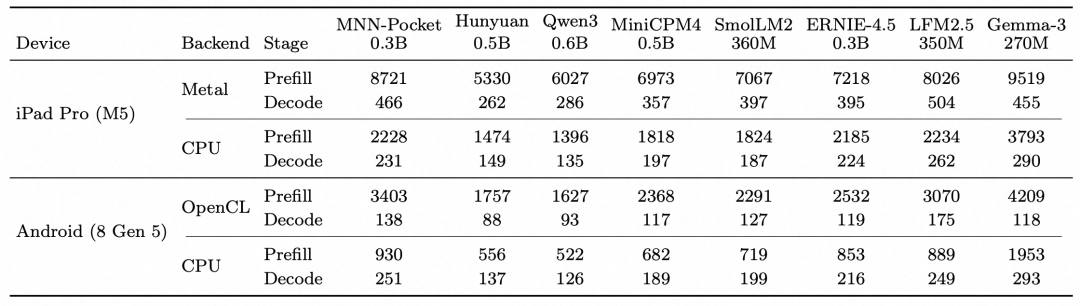
팀은 Apple 및 Android 장치에서 Metal, OpenCL 및 CPU 백엔드를 사용하여 추론 처리량을 평가했습니다. 테스트는 MNN 3.6.2, INT4 양자화 및 통일된 실행 설정을 사용했으며, 각 구성은 한 번 예열하고 다섯 번 측정하여 처리량 중앙값을 취했으며, Prefill과 Decode는 각각 측정했습니다.
- iPad Pro M5/Metal, 512token 테스트 구성에서 MNN-Pocket-0.3B의 Prefill 처리량은 8,721token/s에 도달했으며, Decode 처리량은 466token/s에 도달하여 동일 조건의 Qwen3-0.6B(286token/s)의 약 1.63배에 달했습니다.
- Snapdragon 8 Gen 5의 CPU 백엔드에서 Decode 처리량은 251token/s에 도달했습니다.
아키텍처 및 최적화
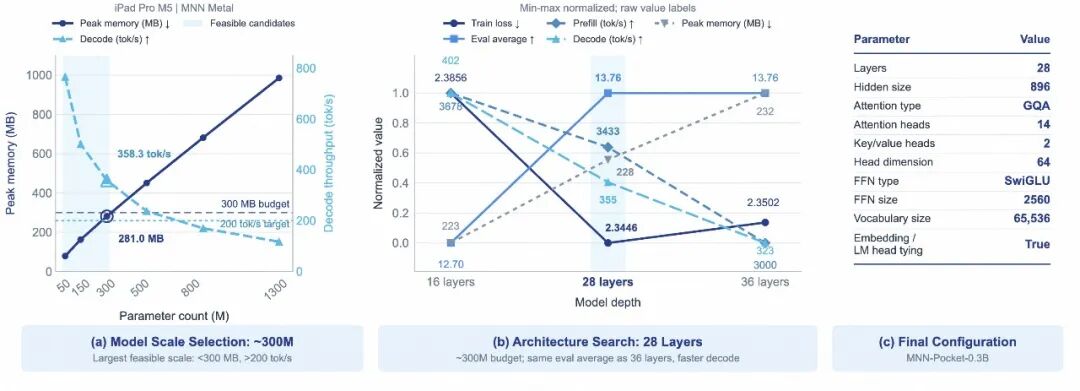
휴대폰 애플리케이션 네이티브 대규모 모델을 위해 팀은 피크 메모리 300MB 미만, 디코딩 처리량 200token/s 초과를 아키텍처 선택 목표로 설정하고, 리소스 예산 내에서 모델 용량을 최대한 보존했습니다. 이 목표를 중심으로 팀은 약 50M에서 1.3B 매개변수를 커버하는 Dense 모델 구성을 구축하고 iPad Pro M5, 통일된 추론 설정에서 테스트했습니다. 약 300M은 이 실험 그룹에서 두 가지 제약 조건을 동시에 만족하는 최대 후보 규모였습니다.
규모를 확정한 후, 팀은 유사한 매개변수 예산 내에서 모델 깊이, 은닉층 너비, 피드포워드 네트워크 및 어텐션 구성을 공동으로 조정했습니다. 16개 층에서 28개 층으로 증가시키자 성능이 향상되었습니다. 36개 층으로 계속 증가시키자 평가 평균 점수는 더 이상 향상되지 않았지만, 디코딩 처리량은 355token/s에서 323token/s로 감소했습니다. 여기서 처리량은 아키텍처 선택 비교에 사용되었으며, 앞서 언급된 최종 배포 버전의 테스트 구성과는 다릅니다.
최종적으로 MNN-Pocket-0.3B는 28개 층 구조를 채택하고 그룹화된 쿼리 어텐션(GQA) 등의 구성을 결합하여 모델 능력, 실행 메모리 및 추론 효율성 사이의 균형을 이루었습니다.
중국어 인터넷 휴대폰 애플리케이션을 위해 MNN-Pocket-0.3B는 중국어와 영어를 중점 지원 언어로 설정하고, 다른 언어의 토큰화 효율성 우선순위를 낮췄습니다. Qwen3 토크나이저를 기반으로 팀은 어휘를 약 151K에서 64K로 간소화하여 어휘 항목 수를 약 57% 줄였고, 임베딩 및 출력 층의 매개변수 및 저장 요구 사항을 줄였으며, 토큰별 생성 시 출력 투영 오버헤드를 낮췄습니다.
전력 소비
전력 소비 측면에서 팀은 OnePlus 13(Snapdragon 8 Gen 5)에서 MNN을 사용하여 MNN-Pocket-0.3B의 4비트 모델에 대한 전력 소비 테스트를 수행했습니다. CPU4 스레드, 입력 1024 및 출력 128 기준 부하에서 배터리 전류 및 전압을 측정하고 유휴 기준 전력 소비를 제외한 결과, 세 번의 테스트에서 환산된 평균 증분 에너지 소비는 약 2.7J/회였습니다. 이 휴대폰의 배터리 용량 6000mAh로 계산하면, 동일한 부하 작업을 100회 실행할 때 누적 증분 에너지 소비는 배터리 총 전력량의 약 0.3%를 차지합니다.
모델 능력
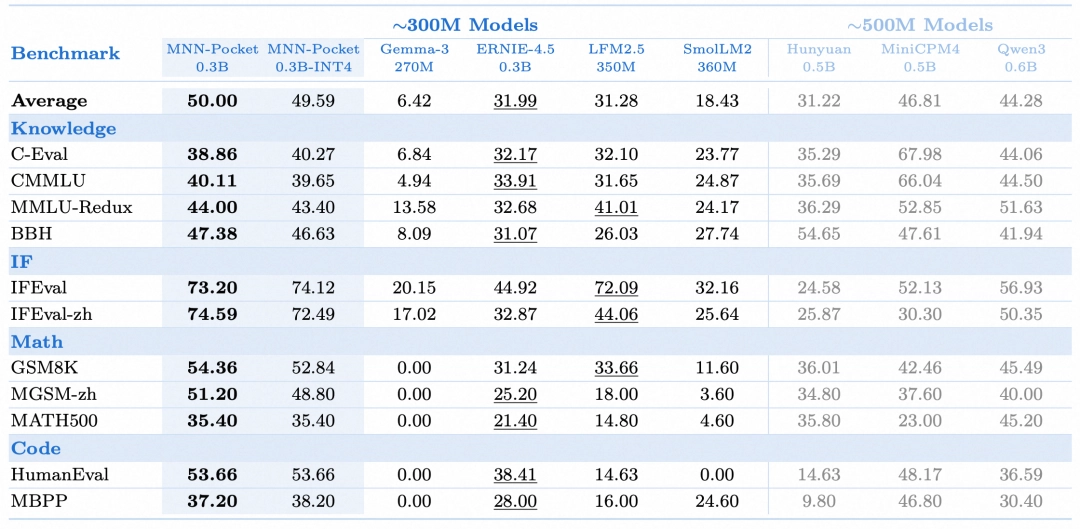
모델 능력 측면에서 기술 보고서에 채택된 평가 설정에서 MNN-Pocket-0.3B의 영어 IFEval 점수는 73.20, 팀이 구축한 중국어 명령 준수 IFEval-zh 점수는 74.59로, 비교된 모델 중 모두 최고 점수를 기록했습니다.
중영문 지식, 추론, 수학, 코드 및 명령 준수를 포함하는 11개 평가에서 모델의 평균 점수는 50.00에 도달하여 보고서에 나열된 동일 규모 모델뿐만 아니라 MiniCPM4-0.5B, Qwen3-0.6B 등 더 큰 규모의 비교 모델보다 높았습니다. 이 중 중국어 수학 MGSM-zh 점수는 51.20, 코드 생성 HumanEval 점수는 53.66이었습니다.
오픈소스 버전
휴대폰 애플리케이션 네이티브 대규모 모델의 가치는 작업 적응 및 애플리케이션 통합을 통해 검증되어야 합니다. 이를 위해 MNN-Pocket-0.3B는 사전 훈련, 사후 훈련부터 엣지 장치 배포까지 여러 버전을 제공하여 연구자와 개발자가 적절한 시작점을 선택하고 계속해서 훈련, 평가 및 애플리케이션을 구축할 수 있도록 합니다.
연구에서 배포까지, MNN 팀은 다양한 단계의 모델 진입점을 오픈소스화했습니다.
- MNN-Pocket-0.3B-Base: 사전 훈련, 도메인 적응 및 기본 능력 연구를 계속합니다.
- MNN-Pocket-0.3B-SFT: 사후 훈련 연구, 강화 학습, 증류 및 제거 실험을 수행합니다.
- MNN-Pocket-0.3B: 범용 명령 호출 및 비즈니스 작업 적응을 지원합니다.
- MNN-Pocket-0.3B-MNN: W4A16 QAT 엣지 장치 배포 버전으로, MNN 추론 엔진의 저비트 연산자 및 하드웨어 백엔드 최적화와 결합하여 특정 장치에서 디코딩 처리량이 466 token/s에 도달할 수 있습니다.
- MNN-Pocket-0.3B-DFlash2: DFlash2 투기적 디코딩 초안 모델로, MNN 추론 엔진의 블록 단위 생성 및 검증 구현과 결합하여 특정 작업에서 디코딩 처리량이 일반적인 자기회귀 디코딩의 2.06배에 달할 수 있습니다.
- MNN-Pocket-0.3B-Dec: 의사결정 헤드를 통해 후보 선택 유형 작업을 완료합니다.
IT之家는 오픈소스 주소를 다음과 같이 첨부합니다.
https://github.com/alibaba/mnn
총평
Taobao MNN 팀이 공개한 MNN-Pocket-0.3B는 휴대폰 애플리케이션에 최적화된 경량 언어 모델입니다. 이 모델은 제한된 리소스 환경에서 높은 디코딩 처리량(최대 466token/s)과 낮은 메모리 사용량(피크 300MB 미만)을 달성하며, 전력 소비도 효율적으로 관리합니다. 특히 중국어와 영어 처리 능력에서 우수한 성능을 보이며, 다양한 오픈소스 버전을 통해 연구 및 개발 커뮤니티의 활용을 지원합니다.
MNN-Pocket-0.3B 模型核心定位与设计目标
淘宝 MNN 团队发布了 MNN-Pocket-0.3B 轻量语言模型,专为手机应用原生大模型场景设计。该模型旨在解决在有限算力、内存和能耗预算下,兼顾任务能力、响应速度与持续运行体验的挑战。
围绕综合型手机应用,团队设定了四个核心维度设计目标:
- 速度(Speed): 在指定设备与上下文配置下,解码吞吐超过 200token/s,力求提供流畅的本地生成体验。
- 内存(Memory): 在指定测试条件下,峰值内存低于 300MB,为系统和应用留出充足资源余量。
- 功耗(Power): 在典型推理负载下,单次推理增量能耗目标不超过参考手机电池能量的万分之一。
- 能力(Capability): 以在指定业务场景上达到 8B 级模型的效果为目标,重点强化指令遵循、中英文理解和世界知识等能力。
性能指标与技术优化
MNN-Pocket-0.3B 是一个约 3 亿参数的轻量化语言模型,团队对其结构、词表、训练数据及推理引擎进行了协同优化。
- 部署体积优势: MNN-Pocket-0.3B 的 INT4 MNN 部署文件体积仅为 173MB。相比之下,Qwen3-0.6B 的部署文件体积为 340MB,MNN-Pocket-0.3B 在此方面减少了约 49%。
- 内存占用优化: 在 iPad Pro M5 测试中,MNN-Pocket-0.3B 的峰值 Metal 驻留内存增量为 228MB,较 Qwen3-0.6B(427MB)减少了约 47%。
- 语言支持优化: 模型重点支持中文与英文。团队基于 Qwen3 分词器将词表从约 151K 精简至 64K,缩减了约 57% 的参数和存储需求。
设备端实测性能表现
在实际硬件测试中,MNN-Pocket-0.3B 展示出优异的效率和吞吐能力:
- iPhone 真机表现: 在 Apple iPhone 18 Pro 上通过 MNN 推理引擎完全离线运行,平均解码(Decode)速度约为 350token/s。
- iPad Pro M5 测试(Metal): 在 iPad Pro M5 的 Metal 后端测试中,MNN-Pocket-0.3B 的 Prefill 吞吐达到 8,721token/s,Decode 吞吐达到 466token/s,约为同条件下的 Qwen3-0.6B(286token/s)的 1.63 倍。
- CPU 后端表现: 在 Snapdragon 8 Gen 5 的 CPU 后端,Decode 吞吐达到了 251token/s。
- 能耗测试: 在 OnePlus 13 上进行功耗测试,执行 100 次同等负载任务累计增量能耗约占电池总电量的 0.3%。
模型架构与能力评估
为在能力、内存和效率之间取得平衡,MNN-Pocket-0.3B 最终采用了 28 层结构并结合了分组查询注意力(GQA)等配置。
- 综合评测得分: 在覆盖中英文知识、推理、数学、代码与指令遵循的 11 项评测中,模型平均得分达到 50.00。
- 专业能力表现: 中文指令遵循 IFEval-zh 得分为 74.59;中文数学 MGSM-zh 得分为 51.20;代码生成 HumanEval 得分为 53.66,均在对比模型中处于领先地位。
开源部署与开发生态
MNN 团队为开发者提供了从研究到部署的完整流程和多个版本入口,支持不同的应用场景需求:
- 基础研究版: MNN-Pocket-0.3B-Base(用于继续预训练、领域适配)。
- 后训练与指令调优版: MNN-Pocket-0.3B-SFT(用于强化学习和蒸馏实验)。
- 通用部署版: MNN-Pocket-0.3B(通用指令调用与业务任务适配)。
- 端侧优化版本: 提供了如 MNN-Pocket-0.3B-MNN (W4A16 QAT 端侧部署) 和 DFlash2 (投机解码草稿模型) 等多种专业化入口,以满足不同设备的硬件后端和推理需求。
总结
MNN-Pocket-0.3B 是一个高度优化的轻量级本地大模型,专为资源受限的手机应用场景设计。它在保持 8B 级模型能力的同事,实现了极低的内存占用(峰值低于 300MB)、高能效和出色的解码吞吐量,显著优化了端侧部署体验。通过提供多阶段、多格式的开源版本,MNN-Pocket-0.3B 为开发者构建高性能、低功耗的原生 AI 应用提供了坚实的基础底座。
MNN-Pocket-0.3Bモデルの公開
IT之家が11月6日に報じたところによると、Taobao傘下のMNNチームは本日、「MNN-Pocket-0.3B」モデルを公開しました。このモデルは、携帯電話アプリケーションのワークロード要件とリソース予算を考慮し、限られたコンピューティング性能、メモリ、およびエネルギー消費の中で、処理能力、応答速度、そして持続的な実行体験のすべてを満たすように設計されています。
チームは、Taobaoのような総合的なモバイルアプリケーションを中心に、「モバイルアプリネイティブな大規模モデル」を以下の4つの設計目標に具体化しました。
- 速度: 指定されたデバイスおよびコンテキスト構成において、デコードスループットが200トークン/秒を超えること。この目標は、高速なクラウドモデルサービスによる生成処理量を参考にしつつ、ローカル環境でスムーズな生成体験を提供することを目的としています。
- メモリ: 指定されたテスト条件下でのピークメモリ使用量が300MB未満であること。携帯電話が8GB〜16GBのメモリを搭載していても、システムや複数のアプリケーションと共有する必要があります。仮にモデルモジュール予算が約500MBの場合、推論時のピークを300MB未満に抑えることで、コンテキスト増加や統合オーバーヘッドに対する余裕を確保できます。
- 消費電力: 一般的な推論負荷(入力512〜1024トークン、出力128トークン)において、単一の推論増分エネルギー消費が参照する携帯電話バッテリーエネルギーの万分の1、すなわち100回分の推論エネルギー消費がバッテリー総エネルギーの1%を超えないようにし、高頻度呼び出しによるバッテリー寿命オーバーヘッドを制御すること。
- 能力: 指定されたビジネスシナリオにおいて、8Bクラスモデルの効果を達成することを目指しています。中国語と英語の理解、世界知識、数学、コード推論能力すべてを考慮しつつ、特に命令遵守能力を強化し、長いコンテキストや多段階タスクのための拡張空間を確保します。
MNNチームは、約3億個のパラメータを持つこの軽量言語モデルをゼロから設計・訓練しました。中国語と英語に重点的に対応しています。モデル構造、語彙、訓練データ、事前学習および事後学習の方法、量子化および推論エンジンを協調的に最適化することで、Taobaoのビジネスやオープンソースコミュニティの開発者に対して、タスク理解能力、高速な応答性、容易な適応と統合が可能な基盤を提供します。
性能
- MNN-Pocket-0.3Bは、Apple iPhone 18 Proでの実測テストにおいて、MNN推論エンジンを通じて完全にオフラインで実行され、平均デコード速度は約350トークン/秒に達しました。
- MNN-Pocket-0.3BのINT4 MNN配布ファイルサイズはわずか173MBであり、モデルウェイト、トークナイザー、計算グラフ、推論構成が含まれています。
- iPad Pro M5、Metalバックエンド、512トークンテスト構成において、モデルロードおよび推論中のピークMetal常駐メモリは、ロード前の基準値から228MB増加しました。
- 同じテスト条件下で比較したところ、Qwen3-0.6Bの配布ファイルサイズは340MB、ピークメモリ増加量は427MBでした。これに対し、MNN-Pocket-0.3Bの配布サイズは約49%減少し、ピークメモリ増加量も約47%減少しました。
モバイルアプリケーションネイティブな大規模モデルにとって、小さな配布サイズはモデルのダウンロードおよび更新コストを削減でき、低い実行メモリ使用量は、ページ、画像、ビデオなどのビジネスモジュールにより多くのスペースを確保し、アプリケーション統合のリソース負担を軽減します。
チームは、AppleおよびAndroidデバイスでMetal、OpenCL、CPUバックエンドを使用して推論スループットを評価しました。テストにはMNN 3.6.2、INT4量子化、統一された実行設定が使用され、各構成は一度ウォームアップし5回測定して中央値を採用し、Prefill(事前入力)とDecode(デコード)をそれぞれ測定しました。
- iPad Pro M5/Metal、512トークンテスト構成において、MNN-Pocket-0.3BのPrefillスループットは8,721トークン/秒に達し、Decodeスループットは466トークン/秒に達しました。これは、同条件下のQwen3-0.6B(286トークン/秒)の約1.63倍にあたります。
- Snapdragon 8 Gen 5のCPUバックエンドでは、Decodeスループットが251トークン/秒に達しました。
アーキテクチャと最適化
モバイルアプリケーションネイティブな大規模モデルを実現するため、チームは「ピークメモリ300MB未満」「デコードスループット200トークン/秒超」をアーキテクチャ選択の目標とし、リソース予算内でモデル容量を最大限に維持しました。この目標に基づき、チームは約50Mから1.3BパラメータをカバーするDenseモデル構成を構築し、iPad Pro M5で統一された推論設定を用いてテストを行いました。約300Mは、この実験グループにおいて二つの制約条件を同時に満たす最大の候補規模でした。
規模を確定した後、チームは類似のパラメータ予算内で、モデルの深さ、隠れ層の幅、フィードフォワードネットワークおよびアテンション構成を共同で調整しました。層数を16層から28層に増加させると性能が向上しましたが、36層まで増やしても評価平均スコアはそれ以上改善しませんでした。しかし、デコードスループットは355トークン/秒から323トークン/秒に減少しました。(このスループットはアーキテクチャ選択の比較に使用されたものであり、前述の最終配布バージョンのテスト構成とは異なります。)
最終的にMNN-Pocket-0.3Bは、28層構造を採用し、Grouped Query Attention (GQA)などの構成を組み合わせることで、モデル能力、実行メモリ、推論効率性のバランスを取りました。
中国のインターネットモバイルアプリケーション向けに、MNN-Pocket-0.3Bは中国語と英語を重点サポート言語として設定し、他の言語のトークン化効率の優先順位を下げました。Qwen3トークナイザーを基盤とし、チームは語彙を約151Kから64Kに簡素化することで、語彙項目数を約57%削減しました。これにより、埋め込み層および出力層のパラメータとストレージ要件が減少し、トークンごとの生成時の出力射影オーバーヘッドも低減されました。
消費電力
消費電力の観点から、チームはOnePlus 13(Snapdragon 8 Gen 5)を用いて、MNN-Pocket-0.3Bの4ビットモデルに対する消費電力テストを実施しました。CPU 4スレッド、入力1024および出力128を基準負荷として測定し、アイドル時のベースライン消費電力を除外した結果、3回のテストで算出された平均増分エネルギー消費は約2.7J/回でした。この携帯電話のバッテリー容量6000mAhに基づくと、同じ負荷作業を100回実行した場合の累積増分エネルギー消費は、バッテリー総電力量の約0.3%に相当します。
モデル性能
モデル能力の面では、技術レポートで採用された評価設定において、MNN-Pocket-0.3Bの英語IFEvalスコアは73.20、チームが構築した中国語命令遵守IFEval-zhスコアは74.59を記録し、比較された全モデルの中で最高点を獲得しました。
中・英・数・コードおよび命令遵守を含む11の評価において、モデルの平均スコアは50.00に達し、レポートに記載されている同規模のモデルだけでなく、MiniCPM4-0.5BやQwen3-0.6Bといったより大規模な比較モデルよりも高い結果を示しました。特に中国語数学MGSM-zhスコアは51.20、コード生成HumanEvalスコアは53.66でした。
オープンソース版
モバイルアプリケーションネイティブな大規模モデルの価値は、タスク適応およびアプリケーション統合を通じて検証される必要があります。このため、MNN-Pocket-0.3Bは、事前学習から事後学習、エッジデバイスへのデプロイメントに至るまで複数のバージョンを提供し、研究者や開発者が適切な開始点を選択し、継続的な訓練、評価、およびアプリケーション構築を行えるようにしています。
MNNチームは、研究からデプロイメントに至るまで、様々な段階のモデルエントリーポイントをオープンソース化しました。
- MNN-Pocket-0.3B-Base: 事前学習、ドメイン適応、および基礎能力の研究に使用します。
- MNN-Pocket-0.3B-SFT: 事後訓練(ファインチューニング)研究、強化学習、蒸留、および除去実験を実施します。
- MNN-Pocket-0.3B: 一般的な命令呼び出しやビジネスタスクへの適応をサポートします。
- MNN-Pocket-0.3B-MNN: W4A16 QATエッジデバイス配布バージョンであり、MNN推論エンジンの低ビット演算子およびハードウェアバックエンド最適化と組み合わさることで、特定のデバイスでデコードスループットが466トークン/秒に達する可能性があります。
- MNN-Pocket-0.3B-DFlash2: DFlash2推測的デコーディングのドラフトモデルであり、MNN推論エンジンのブロック単位生成および検証実装と組み合わせることで、特定のタスクでデコードスループットが通常の自己回帰デコーディングの2.06倍に達する可能性があります。
- MNN-Pocket-0.3B-Dec: 意思決定ヘッドを通じて候補選択タイプのタスクを完了します。
IT之家は、オープンソースアドレスとして以下を提供しています。
https://github.com/alibaba/mnn
まとめ
Taobao MNNチームが公開したMNN-Pocket-0.3Bは、モバイルアプリケーションに最適化された軽量言語モデルです。このモデルは、限られたリソース環境下で高いデコードスループット(最大466トークン/秒)と低いメモリ使用量(ピーク300MB未満)を達成しつつ、消費電力効率も管理しています。特に中国語と英語の処理能力に優れており、複数のオープンソースバージョンを提供することで研究および開発コミュニティの活用を強力に支援します。
MNN-Pocket-0.3B Model Unveiled
According to news from IT之家 on November 6th, the MNN team under Taobao unveiled the MNN-Pocket-0.3B model today. This model is designed to meet performance requirements—including capability, response speed, and sustained execution experience—within limited computing power, memory, and energy consumption, specifically considering the operational demands and resource budgets of mobile phone applications.
Focusing on comprehensive mobile applications like Taobao, the team formalized "Native Mobile Application Large Models" with four specific design goals:
- Speed: Decoding throughput exceeds 200 tokens/s in specified device and context configurations. This goal aims to provide a smooth generation experience locally by referencing high-speed cloud model service generation throughput.
- Memory: Peak memory is less than 300MB under specified test conditions. Even if the phone has 8–16GB of memory, the system and multiple applications must share it. For example, controlling the inference peak below 300MB ensures ample room for context growth and integrated overhead, even with a model module budget of approximately 500MB.
- Power Consumption: The target incremental energy consumption for single inference under typical load (input 512–1024 tokens, output 128 tokens) is set to not exceed 1% of the total battery energy, calculated as one ten-thousandth of the reference phone's battery energy. This controls the battery life overhead from high-frequency calls.
- Capability: Aims to achieve the effectiveness of an 8B model in specified business scenarios, considering Chinese and English comprehension, world knowledge, mathematics, and code reasoning abilities. It emphasizes command adherence while securing expansion space for long contexts and multi-step tasks.
The MNN team designed and trained this lightweight language model, which has approximately 300 million parameters, from scratch, with a focus on supporting Chinese and English. By collaboratively optimizing the model structure, vocabulary, training data, pre-training and post-training methods, quantization, and inference engine, they provide a model foundation for Taobao's business and open-source community developers that offers task understanding, fast response, and easy adaptation and integration.
Performance
- In real-world tests conducted on the Apple iPhone 18 Pro using the MNN inference engine, MNN-Pocket-0.3B ran completely offline with an average decoding speed of approximately 350 tokens/s.
- The INT4 MNN deployment file size for MNN-Pocket-0.3B is only 173MB, which includes model weights, tokenizer, computation graph, and inference configuration.
- On the iPad Pro M5 with a Metal backend in a 512-token test configuration, the peak Metal resident memory increased by 228MB compared to the baseline before loading and during model inference.
- In the same test, Qwen3-0.6B had a deployment file size of 340MB and a peak memory increase of 427MB. Compared to this, MNN-Pocket-0.3B showed an approximate 49% reduction in deployment size and an approximate 47% reduction in peak memory increase.
For native mobile application large models, a small deployment size reduces the cost of model download and updates, while low runtime memory reserves more space for business modules like pages, images, and videos, thereby reducing resource burden during application integration.
The team evaluated inference throughput on Apple and Android devices using Metal, OpenCL, and CPU backends. The tests used MNN 3.6.2, INT4 quantization, and a unified execution setup. For each configuration, the median throughput was taken after one warm-up run and five measurements, measuring Prefill and Decode separately.
- On iPad Pro M5/Metal in a 512-token test configuration, MNN-Pocket-0.3B reached a Prefill throughput of 8,721 tokens/s and a Decode throughput of 466 tokens/s, which is approximately 1.63 times that of Qwen3-0.6B (286 tokens/s) under the same conditions.
- On the Snapdragon 8 Gen 5 CPU backend, the Decode throughput reached 251 tokens/s.
Architecture and Optimization
For native mobile application large models, the team set the goals of keeping peak memory below 300MB and achieving decoding throughput exceeding 200 tokens/s, thereby maximizing model capacity within resource budgets. Based on these targets, the team built a Dense model configuration covering parameters from approximately 50M to 1.3B and tested it on the iPad Pro M5 with a unified inference setup. Approximately 300M was the largest candidate size that satisfied both constraints in this experimental group.
After fixing the scale, the team jointly adjusted the model depth, hidden layer width, feed-forward network, and attention configuration within a similar parameter budget. Performance improved when increasing from 16 layers to 28 layers. However, further increasing it to 36 layers did not improve the average evaluation score, but reduced the decoding throughput from 355 tokens/s to 323 tokens/s. (Note: The throughput here was used for architecture comparison and differs from the test configuration of the final deployed version mentioned earlier.)
Ultimately, MNN-Pocket-0.3B adopted a 28-layer structure combined with configurations like Grouped Query Attention (GQA) to balance model capability, runtime memory, and inference efficiency.
For Chinese internet mobile applications, MNN-Pocket-0.3B prioritized supporting Chinese and English as primary languages and lowered the priority for tokenization efficiency of other languages. Based on the Qwen3 tokenizer, the team simplified the vocabulary from about 151K to 64K, reducing the number of vocabulary items by approximately 57%, which reduced the parameter and storage requirements for embedding and output layers, and lowered the output projection overhead per token generation.
Power Consumption
Regarding power consumption, the team conducted a test on the MNN-Pocket-0.3B 4-bit model using MNN on the OnePlus 13 (Snapdragon 8 Gen 5). By measuring battery current and voltage under a load of CPU4 threads, input 1024, and output 128, excluding idle baseline power consumption, the average incremental energy consumption across three tests was approximately 2.7J/call. Considering this phone's 6000mAh battery capacity, running the same workload 100 times resulted in a cumulative incremental energy consumption that accounted for only about 0.3% of the total battery power.
Model Capability
In terms of model capability, MNN-Pocket-0.3B achieved an English IFEval score of 73.20 and a Chinese command adherence IFEval-zh score of 74.59 in the evaluation settings adopted for the technical report, scoring highest among all compared models.
Across 11 evaluations—including Chinese/English knowledge, reasoning, mathematics, code, and command adherence—the model achieved an average score of 50.00. This was higher than not only other similarly sized models listed in the report but also larger comparative models like MiniCPM4-0.5B and Qwen3-0.6B. Specifically, its Chinese math MGSM-zh score was 51.20, and the code generation HumanEval score was 53.66.
Open Source Versions
The value of a native mobile application large model must be validated through task adaptation and application integration. To facilitate this, MNN-Pocket-0.3B provides multiple versions—from pre-training to post-training and edge device deployment—allowing researchers and developers to choose an appropriate starting point for continued training, evaluation, and application building.
The MNN team has open-sourced model entry points at various stages, from research to deployment:
- MNN-Pocket-0.3B-Base: For continuing pre-training, domain adaptation, and basic capability research.
- MNN-Pocket-0.3B-SFT: For conducting post-training research, reinforcement learning, distillation, and removal experiments.
- MNN-Pocket-0.3B: Supports general command calling and business task adaptation.
- MNN-Pocket-0.3B-MNN: An edge device deployment version using W4A16 QAT, which combines MNN inference engine's low-bit operators and hardware backend optimization to achieve a decoding throughput of 466 tokens/s on specific devices.
- MNN-Pocket-0.3B-DFlash2: A DFlash2 speculative decoding draft model, combining with MNN inference engine's block-wise generation and verification implementation to achieve a decoding throughput up to 2.06 times that of standard autoregressive decoding for certain tasks.
- MNN-Pocket-0.3B-Dec: Completes candidate selection type tasks through a decision head.
IT之家 provides the open-source address as follows:
https://github.com/alibaba/mnn
Summary
The MNN-Pocket-0.3B, unveiled by Taobao's MNN team, is a lightweight language model optimized for mobile applications. It achieves high decoding throughput (up to 466 tokens/s) and low memory usage (peak below 300MB) within resource constraints while efficiently managing power consumption. The model demonstrates superior performance in Chinese and English capabilities and supports the research community through multiple open-source versions.