시장 개황
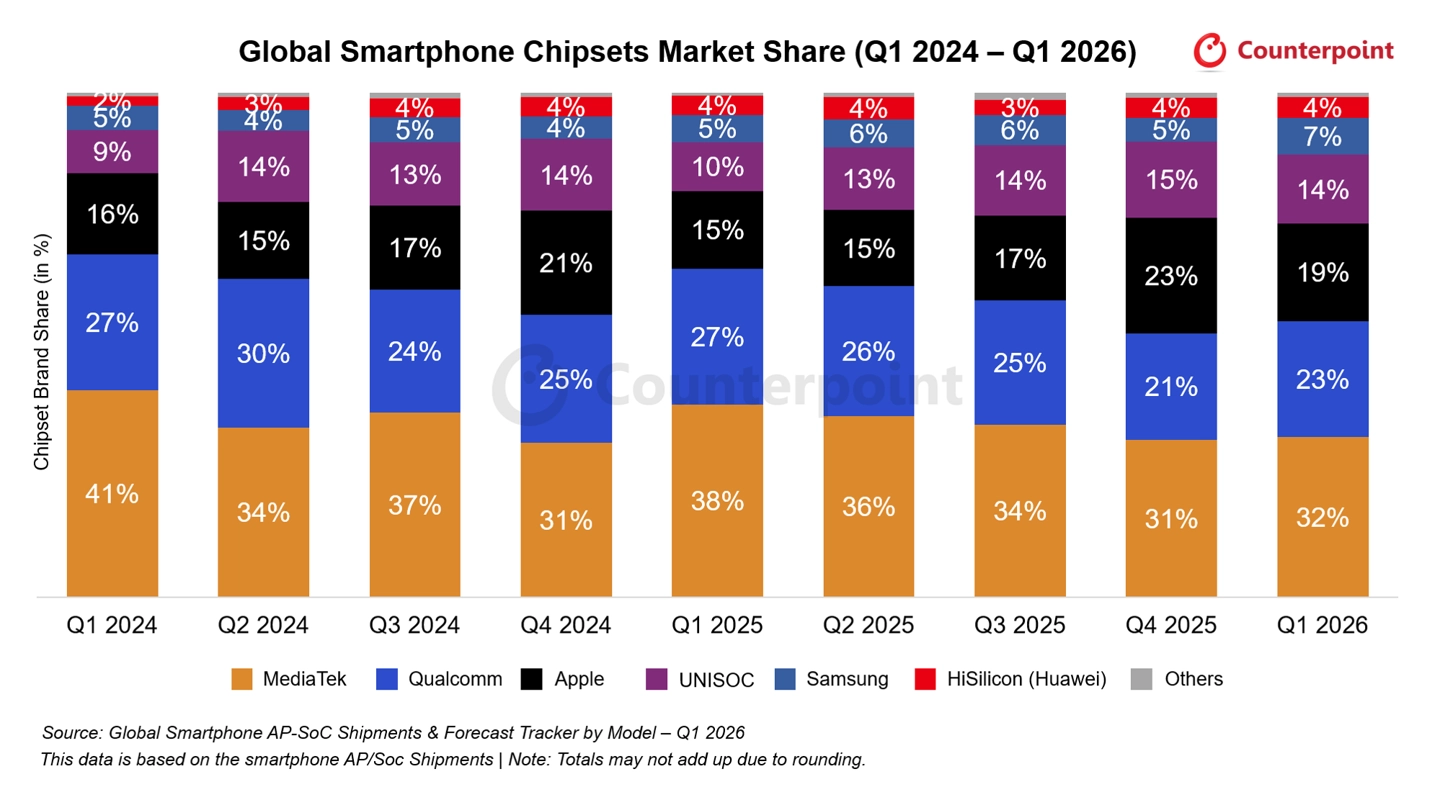
시장 조사 기관 Counterpoint는 이번 주 월요일 2026년 1분기 글로벌 스마트폰 AP-SoC 시장 점유율 데이터를 발표했습니다.
전체 시장을 살펴보면, 2026년 1분기 전 세계 스마트폰 SoC 출하량은 전년 동기 대비 8% 감소했습니다. Counterpoint 분석가는 지속적인 메모리 공급 부족이 전체 출하량 감소의 주요 원인이라고 분석했습니다.
주요 제조사 점유율
- MediaTek: 32% (1위)
- Qualcomm: 23% (2위)
- Apple: 19% (3위)
- Unisoc: 14% (4위)
- Samsung: 7% (5위)
- HiSilicon: 4% (6위)
Apple 및 MediaTek 동향
Apple의 경우, iPhone 17e 시리즈 출시와 iPhone 17 시리즈(특히 Pro 모델)의 판매 호조에 힘입어 칩 출하량이 전년 대비 증가했습니다. Apple의 글로벌 스마트폰 SoC 시장 점유율은 2025년 1분기 15%에서 2026년 1분기 19%로 성장했으나, 2025년 4분기(23%)보다는 낮은 수준입니다.
MediaTek의 경우 2026년 1분기 전체 출하량이 전년 대비 감소했습니다. 주력 및 보급형 시장에서는 지속적인 메모리 부족이 타격을 입혔으며, 하이엔드 시장에서도 소폭 하락했습니다. 다만 Dimensity 8000 시리즈 중 Dimensity 8450은 해당 칩을 탑재한 OPPO Reno15 시리즈의 좋은 성과에 힘입어 출하량이 증가했습니다.
Qualcomm 및 Samsung 동향
Qualcomm의 출하량 또한 2026년 1분기에 전년 대비 감소했습니다. 하이엔드 시장은 Samsung Galaxy S26 시리즈 출시 지연의 영향을 받았으며, 일부 지역에서 삼성 기본 모델에 자사 Exynos 2600 칩을 채택하면서 Qualcomm Snapdragon 플래그십 칩의 점유 공간이 압박을 받았습니다. 또한, Snapdragon 600 및 400 시리즈는 메모리 부족과 재고 누적의 영향으로 출하량이 감소했습니다.
반면 Samsung 자체 Exynos 칩은 2026년 1분기 출하량이 전년 대비 증가했습니다. 하이엔드 시장에서는 Galaxy S26 시리즈 출시와 함께 기본 모델에 탑재된 Exynos 2600의 성장이 기여했으며, 중저가 시장에서도 Exynos 1680을 탑재한 Samsung Galaxy A57 및 Exon 1480을 탑재한 Samsung Galaxy A37이 출하량 증가를 견인했습니다.
HiSilicon 및 Unisoc 동향
HiSilicon은 2026년 1분기 출하량이 감소했으나 여전히 4%의 점유율을 유지하고 있습니다. Huawei Mate 80 시리즈 출시로 하이엔드 시장에서는 성장이 있었으나, Huawei Nova 15 시리즈가 2025년 4분기에 조기 출시되면서 수요가 이전 분기로 이동해 중저가 시장의 1분기 출하량은 다소 감소했습니다.
Unisoc는 Redmi와의 협력에 힘입어 2026년 1분기 출하량이 전년 대비 증가했습니다. 4G 영역에서는 Unisoc T7250 칩의 설계 수주가 LTE 제품 출하를 뒷받침했으며, 보급형 5G 스마트폰 분야에서 Unisoc T8300 칩이 주요 제조사의 주문을 지속적으로 확보하며 시장 점유율 성장을 견인했습니다.
총평
2026년 1분기 글로벌 SoC 시장은 메모리 공급 부족으로 인해 전체 출하량이 감소했으나, 제조사별로 희비가 엇갈리는 양상을 보였습니다. MediaTek이 압도적인 점유율로 1위를 수성한 가운데, Samsung의 Exynos와 Unisoc은 전략적 파트너십 및 특정 모델의 배치에 따라 견고한 성장세를 나타냈습니다.
市场概况与份额排名
根据 Counterpoint 发布的报告,2026 年第一季度全球智能手机 SoC 出货量受持续的内存供应短缺影响,整体出货量同比下降 8%。
- MediaTek:32%
- Qualcomm:23%
- Apple:19%
- 紫光展锐:14%
- Samsung:7%
- 海思:4%
主要厂商表现分析
Apple 的市场份额从 2025 年第一季度的 15% 增长至 19%,这一增长主要得益于搭载 A19 芯片的 iPhone 17e 系列以及 iPhone 17 系列(尤其是 Pro 系列)在多个市场的强劲表现。
MediaTek 的整体出货量有所下降,受到内存短缺和高端市场需求波动的影响。但在 Dimensity 8000 系列中,Dimensity 8450 由于搭载于 OPPO Reno15 系列并获得良好市场反馈,其出货量有所增长。
其他厂商动态
Qualcomm 的出货量在 2026 年第一季度下降。主要原因包括 Samsung Galaxy S26 系列推迟发布、部分地区基础版机型采用 Exynos 2600 芯片挤压了骁龙旗舰芯片空间,以及骁龙 600 和 400 系列面临的内存短缺和库存积压。
Samsung 的 Exynos 芯片出货量同比增长。其中,Exynos 2600 受 Galaxy S26 系列带动;Exynos 1680(搭载于 Galaxy A57)和 Exynos 1480(搭载于 Galaxy A37)在中端市场贡献了增量。
海思保持 4% 的份额。Mate 80 系列推动了高端市场增长,但由于 Nova 15 系列提前发布到上一季度,导致中端市场在 Q1 出货量下滑。
紫光展锐通过与 REDMI 的合作实现出货量同比增长。其中 T7250 芯片支撑了 4G 领域产品,T8300 芯片在入门级 5G 智能手机领域持续获得订单。
总结
2026 年第一季度全球智能手机 SoC 市场因内存短缺导致整体出货量下降 8%,但各品牌表现呈现显著分化。Apple 和 Samsung 的 Exynos 系列在特定机型推动下实现增长,而 MediaTek、Qualcomm 及海思则在不同细分领域面临不同的市场压力与机遇。
市場概況
調査機関のCounterpointは、今週月曜日に2026年第1四半期のグローバルスマートフォンAP-SoC市場シェアデータを発表しました。
市場全体を俯瞰すると、2026年第1四半期の世界的なスマートフォンSoC出荷量は前年同期比で8%減少しました。Counterpointのアナリストは、継続的なメモリ供給不足が全体の出荷量減少の主な要因であると分析しています。
主要メーカーのシェア
- MediaTek: 32%(1位)
- Qualcomm: 23%(2位)
- Apple: 19%(3位)
- Unisoc: 14%(4位)
- Samsung: 7%(5位)
- HiSilicon: 4%(6位)
AppleおよびMediaTekの動向
Appleについては、iPhone 17eシリーズの発売とiPhone 17シリーズ(特にProモデル)の好調な販売に支えられ、チップ出荷量が増加しました。AppleのグローバルスマートフォンSoC市場シェアは、2025年第1四半期の15%から2026年第1四項期には19%へと成長しましたが、2025年第4四半期(23%)よりは低い水準にとどまっています。
MediaTekについては、2026年第1四半期の総出荷量が前年同期比で減少しました。主力および普及型市場では継続的なメモリ不足が打撃となり、ハイエンド市場でもわずかに減少しました。ただし、Dimensity 8000シリーズのうち、Dimensity 8450は同チップを搭載したOPPO Reno15シリーズの好調な結果により、出荷量が増加しました。
QualcommおよびSamsungの動向
Qualcommの出荷量も2026年第1四項期には前年同期比で減少しました。ハイエンド市場はSamsung Galaxy S26シリーズの発売遅延の影響を受け、一部の地域ではSamsungのベースモデルに自社Exynos 2600チップを採用したことで、Qualcomm Snapdragonフラッグシップチップのシェアが圧迫されました。また、Snapdragon 600および400シリーズは、メモリ不足と在庫の積み上がりの影響で出荷量が減少しました。
一方、Samsung独自のExynosチップは2026年第1四項期に出荷量が増加しました。ハイエンド市場ではGalaxy S26シリーズの発売に伴い、ベースモデルに搭載されたExynos 2600の成長が寄与し、中低価格帯市場でもExynos 1680を搭載したSamsung Galaxy A57およびExon 1480を搭載したSamsung Galaxy A37が出荷量の増加を牽引しました。
HiSiliconおよびUnisocの動向
HiSiliconは2026年第1四項期に出荷量が減少したものの、依然として4%のシェアを維持しています。Huawei Mate 80シリーズの発売によりハイエンド市場では成長が見られたものの、Huawei Nova 15シリーズが2025年第4四項期に早期リリースされたことで需要が前四項期に移動し、中低価格帯市場の第1四項期の出荷量はわずかに減少しました。
UnisocはRedmiとの協力により、2026年第1四項期の出荷量が前年同期比で増加しました。4G領域ではUnisoc T7250チップの設計受注がLTE製品の出荷を支え、普及型5Gスマートフォン分野ではUnisoc T8300チップが主要メーカーからの継続的な注文を獲得し、市場シェアの成長を牽引しました。
総評
2026年第1四項期のグローバルSoC市場は、メモリ供給不足により全体の出荷量が減少したものの、メーカーごとに明暗が分かれる結果となりました。MediaTekが圧倒的なシェアで首位を維持する一方で、SamsungのExynosとUnisocは戦略的パートナーシップや特定モデルの配置によって堅調な成長を見せました。
まとめ
2026年第1四項期のグローバルSoC市場はメモリ不足の影響で全体出荷量が減少しましたが、MediaTekが首位を堅持する一方で各社の動向には差異が見られました。特にSamsungのExynosやUnisocは、戦略的な提携や特定のモデル展開により堅調な成長を記録しています。
Market Overview
The market research firm Counterpoint released data regarding global smartphone AP-SoC market shares for the first quarter of 2026 this past Monday.
Looking at the overall market, global smartphone SoC shipments in Q1 2026 decreased by 8% compared to the same period last year. Counterpoint analysts analyzed that persistent memory supply shortages were the primary cause for the decline in total shipment volume.
Major Manufacturer Market Share
- MediaTek: 32% (1st)
- Qualcomm: 23% (2nd)
- Apple: 19% (3rd)
- Unisoc: 14% (4th)
- Samsung: 7% (5th)
- HiSilicon: 4% (6th)
Trends for Apple and MediaTek
In the case of Apple, chip shipments increased year-over-year, bolstered by the release of the iPhone 17e series and strong sales of the iPhone 17 series (particularly the Pro models). Apple's global smartphone SoC market share grew from 15% in Q1 2025 to 19% in Q1 2026, though this remains lower than the 23% recorded in Q4 2025.
For MediaTek, total shipments in Q1 2026 decreased compared to the previous year. The mid-to-low-end markets were hit by continuous memory shortages, and the high-end market also saw a slight decline. However, within the Dimensity 8000 series, the Dimensity 8450 saw an increase in shipments thanks to the strong performance of the OPPO Reno15 series, which features that chip.
Trends for Qualcomm and Samsung
Qualcomm's shipment volume also decreased in Q1 2026 compared to the previous year. The high-end market was affected by delays in the launch of the Samsung Galaxy S26 series, and in some regions, the adoption of their own Exynos 2600 chips for base models pressured the market share available for Qualcomm Snapdragon flagship chips. Additionally, shipments for the Snapdragon 600 and 400 series declined due to memory shortages and inventory accumulation.
In contrast, Samsung's proprietary Exynos chips saw an increase in shipment volume in Q1 2026 compared to the previous year. In the high-end market, growth was contributed by the Exynos 2600 used in base models of the Galaxy S26 series. In the mid-to-low-end market, shipments were driven by the Samsung Galaxy A57 equipped with the Exynos 1680 and the Samsung Galaxy A37 equipped with the Exon 1480.
Trends for HiSilicon and Unisoc
HiSilicon's shipment volume decreased in Q1 2026, but it maintained a market share of 4%. While there was growth in the high-end market due to the launch of the Huawei Mate 80 series, the early release of the Huawei Nova 15 series in Q4 2025 shifted demand to the previous quarter, leading to a slight decrease in Q1 shipments for the mid-to-low-end market.
Unisoc saw an increase in shipment volume in Q1 2026 compared to the previous year, bolstered by its collaboration with Redmi. In the 4G segment, design wins for the Unisoc T7250 chip supported LTE product shipments, while in the budget 5G smartphone sector, the Unisoc T8300 chip drove market share growth by consistently securing orders from major manufacturers.
Overall Conclusion
While the global SoC market in Q1 2026 saw a decline in overall shipments due to memory supply shortages, results varied significantly among manufacturers. While MediaTek maintained its dominant first-place position, Samsung's Exynos and Unisoc showed steady growth driven by strategic partnerships and specific model placements.
SummaryThe global smartphone SoC market experienced an 8% decline in Q1 2026 primarily due to memory shortages. While MediaTek remains the market leader, companies like Samsung (Exynos) and Unisoc saw growth through strategic partnerships and successful high-volume model placements.
市场概况
根据 Counterpoint 发布的数据,2026 年第一季度全球智能手机 SoC 出货量受持续的内存供应短缺影响,整体同比下降 8%。
- MediaTek:32%(位居榜首)
- Qualcomm:23%
- Apple:19%
- 紫光展锐:14%
- Samsung:7%
- 海思:4%
主要厂商表现分析
Apple 的芯片出货量同比增长,市场份额从 2025 年第一季度的 15% 提升至 2026 年第一季度的 19%,这主要得益于搭载 A19 的 iPhone 17e 系列以及 iPhone 17 Pro 系列的强劲表现。
MediaTek 在 2026 年第一季度整体出货量下滑,受到内存短缺对主流及入门级市场的影响。但在高端市场中,Dimensity 8450 因搭载于 OPPO Reno15 系列而有所增长。
Qualcomm 出货量同比下降,原因包括 Samsung Galaxy S26 系列推迟发布、部分机型采用 Exynos 芯片挤压空间,以及骁龙 600 和 400 系列面临的内存短缺和库存积压问题。
Samsung 的 Exynos 芯片出货量同比增长。其中,Exynos 2600 受 Galaxy S26 系列带动;中端市场则由搭载 Exynos 1680 的 Galaxy A57 和搭载 Exynos 1480 的 Galaxy A37 提供增长动力。
海思保持 4% 的市场份额。虽然 Mate 80 系列推动了高端市场出货,但由于 Nova 15 系列提前发布导致中端市场在第一季度的需求流失。
紫光展锐通过与 REDMI 的合作实现出货量同比增长。其中,T7250 芯片支撑了 LTE 产品,而 T8300 芯片则在入门级 5G 领域获得大量订单。
总结
2026 年第一季度全球智能手机 SoC 出货量因内存短缺导致整体下滑。各品牌表现分化明显:MediaTek 位居榜首,Apple 份额有所增长;Samsung 和紫光展锐受益于特定机型和合作推动增长,而 Qualcomm 则受到市场竞争及供应链因素影响导致出货下降。
市場動向
調査機関のCounterpointは、今週月曜日に2026年第1四半期のグローバルスマートフォンAP-SoC市場シェアデータを発表しました。
市場全体を概観すると、2026年第1四半期の世界的なスマートフォンSoC出荷量は前年同期比で8%減少しました。Counterpointの分析担当者は、継続的なメモリ供給不足が全体の出荷量減少の主な要因であると分析しています。
主要メーカーのシェア
- MediaTek: 32%(1位)
- Qualcomm: 23%(2位)
- Apple: 19%(3位)
- Unisoc: 14%(4位)
- Samsung: 7%(5位)
- HiSilicon: 4%(6位)
AppleおよびMediaTekの動向
Appleについては、iPhone 17eシリーズの発売とiPhone 17シリーズ(特にProモデル)の好調な販売に支えられ、チップ出荷量が増加しました。AppleのグローバルスマートフォンSoC市場シェアは、2025年第1四半期の15%から2026年第1四半期には19%へと成長しましたが、2025年第4四半期(23%)よりは低い水準となっています。
MediaTekについては、2026年第1四半期の総出荷量が前年同期比で減少しました。主力および普及型市場では継続的なメモリ不足が打撃となり、ハイエンド市場でもわずかに減少しました。しかし、Dimensity 8000シリーズのうち、Dimensity 8450は搭載されたOPPO Reno15シリーズの好調な結果により、出荷量が増加しました。
QualcommおよびSamsungの動向
Qualcommの出荷量も2026年第1四半期には前年同期比で減少しました。ハイエンド市場はSamsung Galaxy S26シリーズの発売遅延の影響を受け、一部の地域ではSamsungのベースモデルに自社のExynos 2600チップを採用したことで、Qualcomm Snapdragonフラッグシップチップのシェアが圧迫されました。また、Snapdragon 600および400シリーズはメモリ不足と在庫の積み上がりの影響で出荷量が減少しました。
一方、Samsung独自のExynosチップは、2026年第1四半期の出荷量が増加しました。ハイエンド市場ではGalaxy S26シリーズの発売に伴い、ベースモデルに搭載されたExynos 2600の成長が寄与し、中低価格帯市場でもExynos 1680を搭載したSamsung Galaxy A57やExon 1480を搭載したSamsung Galaxy A37が出荷量の増加を牽引しました。
HiSiliconおよびUnisocの動向
HiSiliconは、2026年第1四半期の出荷量は減少したものの、依然として4%のシェアを維持しています。Huawei Mate 80シリーズの発売によりハイエンド市場では成長が見られたものの、Huawei Nova 15シリーズが2025年第4四半期に早期リリースされたため、需要が前四半期に移動し、中低価格帯市場の第1四半期出荷量はやや減少しました。
UnisocはRedmiとの提携により、2026年第1四半期の出荷量が増加しました。4G領域ではUnisoc T7250チップの設計受注がLTE製品の出荷を支え、普及型5Gスマートフォン分野ではUnisoc T8300チップが主要メーカーからの継続的な注文を獲得し、市場シェアの成長を牽引しました。
まとめ
2026年第1四半期のグローバルSoC市場は、メモリ供給不足により全体の出荷量が減少したものの、メーカーごとに明暗が分かれる結果となりました。MediaTekが圧倒的なシェアで首位を維持する一方で、SamsungのExynosやUnisocは戦略的パートナーシップや特定モデルへの採用によって堅調な成長を見せました。
Market Overview
The market research firm Counterpoint released data on global smartphone AP-SoC market shares for the first quarter of 2026 this Monday.
Looking at the overall market, global smartphone SoC shipments in Q1 2026 decreased by 8% compared to the same period last year. Counterpoint analysts attributed this decline in total volume primarily to a persistent shortage in memory supply.
Manufacturer Market Share
- MediaTek: 32% (Ranked 1st)
- Qualcomm: 23% (Ranked 2nd)
- Apple: 19% (Ranked 3rd)
- Unisoc: 14% (Ranked 4th)
- Samsung: 7% (Ranked 5th)
- HiSilicon: 4% (Ranked 6th)
Apple and MediaTek Trends
In the case of Apple, chip shipments increased year-over-year, bolstered by the launch of the iPhone 17e series and strong sales of the iPhone 17 series (particularly the Pro models). Apple's global smartphone SoC market share grew from 15% in Q1 2025 to 19% in Q1 2026, though this remains lower than the 23% recorded in Q4 2025.
For MediaTek, total shipments in Q1 2026 saw a year-over-year decline. The flagship and budget markets were hit by ongoing memory shortages, and the high-end market also experienced a slight decrease. However, within the Dimensity 8000 series, the Dimensity 8450 saw an increase in shipments thanks to the strong performance of the OPPO Reno15 series equipped with that chip.
Qualcomm and Samsung Trends
Qualcomm's shipment volume also decreased year-over-year in Q1 2026. The high-end market was impacted by delays in the launch of the Samsung Galaxy S26 series, and in some regions, the adoption of its own Exynos 2600 chips in base models pressured the market share of Qualcomm Snapdragon flagship chips. Additionally, shipments for the Snapdragon 600 and 400 series declined due to memory shortages and accumulated inventory.
In contrast, Samsung's proprietary Exynos chips saw an increase in shipment volume in Q1 2026 compared to the previous year. In the high-end market, growth was driven by the Exynos 2600 used in base models of the Galaxy S26 series. The mid-to-low range market also saw growth led by the Samsung Galaxy A57 featuring the Exynos 1680 and the Samsung Galaxy A37 equipped with the Exynos 1480.
HiSilicon and Unisoc Trends
While HiSilicon's shipment volume decreased in Q1 2026, it maintained a 4% market share. The launch of the Huawei Mate 80 series drove growth in the high-end market; however, because the Huawei Nova 15 series was released early in Q4 2025, demand shifted to the previous quarter, resulting in a slight decline in Q1 shipment volume for the mid-to-low range market.
Unisoc saw an increase in shipments year-over-year in Q1 2026, bolstered by its collaboration with Redmi. In the 4G segment, design wins for the Unisoc T7250 chip supported LTE product shipments, while the Unisoc T8300 chip drove market share growth in the budget 5G smartphone sector by consistently securing orders from major manufacturers.
Overall Outlook
The global SoC market in Q1 2026 saw a decline in total shipments due to memory supply shortages, yet results varied significantly among manufacturers. While MediaTek maintained its dominant first-place position, Samsung's Exynos and Unisoc demonstrated robust growth driven by strategic partnerships and the deployment of specific models.
Summary
The global smartphone SoC market saw a 8% year-over-year decline in Q1 2026 primarily due to memory supply shortages. While MediaTek remains the market leader, other manufacturers like Samsung and Unisoc achieved growth through specific model placements and strategic partnerships despite the overall market contraction.
2026年第一季度全球智能手机AP-SoC市场份额
根据Counterpoint发布的报告,2026年第一季度全球智能手机SoC出货量整体同比下降8%,主要原因是持续的内存供应短缺。各厂商的市场份额分布如下:
- MediaTek:32%(位居榜首)
- Qualcomm:23%
- Apple:19%
- 紫光展锐:14%
- Samsung:7%
- 海思:4%
主要厂商表现分析
Apple的芯片出货量同比增长,市场份额从2025年Q1的15%提升至2026年Q1的19%。这一增长主要得益于搭载A19芯片的iPhone 17e系列以及iPhone 17系列(尤其是Pro系列)在多个市场的强劲表现。
MediaTek整体出货量出现下滑,受内存短缺影响显著。但在高端市场中,Dimensity 8450凭借OPPO Reno15系列的良好表现实现了出货增长。
Qualcomm的出货量同样受到冲击。主要原因包括Samsung Galaxy S26系列发布推迟、部分基础款机型采用Exynos芯片导致的份额流失,以及骁龙600和400系列面临的内存短缺与库存积压问题。
三星及其他厂商动态
Samsung自家的Exynos芯片出货量同比增长。其中,Exynos 2600受益于Galaxy S26基础版机型;Exynos 1680和Exynos 1480则在Galaxy A57和Galaxy A37等中端机型中贡献了增量。
海思半导体出货量同比下降,但仍维持4%的份额。Mate 80系列带动高端市场增长,但由于Nova 15系列提前发布,导致部分需求流向2025年第四季度,影响了Q1的中端市场表现。
紫光展锐出货量同比增长。得益于与REDMI的合作,T7250芯片在4G领域表现稳健,而T8300芯片在入门级5G智能手机领域持续获得头部厂商订单。
总结
2026年第一季度全球智能手机SoC市场因内存短缺导致整体出货量下降8%,但各品牌表现分化明显。MediaTek稳居榜首,Apple与Samsung Exynos在特定系列中实现增长;而Qualcomm受产品推迟及竞争影响有所下滑。紫光展锐通过合作显著提升了4G和入门级5G市场的份额。
市場概況
調査機関のCounterpointは、2026年第1四半期のグローバルスマートフォンAP-SoC市場シェアに関するデータを発表しました。
市場全体を俯瞰すると、2026年第1四半期の世界的なスマートフォンSoC出荷量は前年同期比で8%減少しました。Counterpointのアナリストは、継続的なメモリ供給不足が全体の出荷量減少の主な要因であると分析しています。
主要メーカーのシェア
- MediaTek: 32%(1位)
- Qualcomm: 23%(2位)
- Apple: 19%(3位)
- Unisoc: 14%(4位)
- Samsung: 7%(5位)
- HiSilicon: 4%(6位)
AppleおよびMediaTekの動向
Appleについては、iPhone 17eシリーズの発売とiPhone 17シリーズ(特にProモデル)の好調な販売に支えられ、チップ出荷量が増加しました。AppleのグローバルスマートフォンSoC市場シェアは、2025年第1四半期の15%から2026年第1四半期には19%へと成長しましたが、2025年第4四半期(23%)よりは低い水準にとどまっています。
MediaTekについては、2026年第1四半期の総出荷量が前年同期比で減少しました。主力および普及型市場では継続的なメモリ不足が打撃となり、ハイエンド市場でもわずかに減少しました。ただし、Dimensity 8000シリーズのうち、Dimensity 8450は同チップを搭載したOPPO Reno15シリーズの好調な結果により、出荷量が増加しました。
QualcommおよびSamsungの動向
Qualcommの出荷量も2026年第1四項期には前年同期比で減少しました。ハイエンド市場はSamsung Galaxy S26シリーズの発売遅延の影響を受け、一部の地域ではSamsungのベースモデルに自社Exynos 2600チップを採用したことで、Qualcomm Snapdragonフラッグシップチップのシェアが圧迫されました。また、Snapdragon 600および400シリーズは、メモリ不足と在庫の積み上がりの影響で出荷量が減少しました。
一方、Samsung独自のExynosチップは2026年第1四項期に出荷量が増加しました。ハイエンド市場ではGalaxy S26シリーズの発売に伴い、ベースモデルに搭載されたExynos 2600の成長が寄与し、中低価格帯市場でもExynos 1680を搭載したSamsung Galaxy A57およびExon 1480を搭載したSamsung Galaxy A37が出荷量の増加を牽引しました。
HiSiliconおよびUnisocの動向
HiSiliconは2026年第1四項期に出荷量が減少したものの、依然として4%のシェアを維持しています。Huawei Mate 80シリーズの発売によりハイエンド市場では成長が見られたものの、Huawei Nova 15シリーズが2025年第4四項期に早期リリースされたことで需要が前四項期に移動し、中低価格帯市場の第1四項期の出荷量はわずかに減少しました。
UnisocはRedmiとの協力により、2026年第1四項期の出荷量が前年同期比で増加しました。4G領域ではUnisoc T7250チップの設計受注がLTE製品の出荷を支え、普及型5Gスマートフォン分野ではUnisoc T8300チップが主要メーカーからの継続的な注文を獲得し、市場シェアの成長を牽引しました。
総評
2026年第1四項期のグローバルSoC市場は、メモリ供給不足により全体の出荷量が減少したものの、メーカーごとに明暗が分かれる結果となりました。MediaTekが圧倒的なシェアで首位を維持する一方で、SamsungのExynosとUnisocは戦略的パートナーシップや特定モデルの配置によって堅調な成長を見せました。
まとめ
2026年第1四項期のグローバルSoC市場はメモリ不足の影響で全体出荷量が減少しましたが、MediaTekが首位を堅持する一方で各社の動向には差異が見られました。特にSamsungのExynosやUnisocは、戦略的な提携や特定のモデル展開により堅調な成長を記録しています。
Market Overview
The market research firm Counterpoint released data regarding global smartphone AP-SoC market shares for the first quarter of 2026 this past Monday.
Looking at the overall market, global smartphone SoC shipments in Q1 2026 decreased by 8% compared to the same period last year. Counterpoint analysts analyzed that persistent memory supply shortages were the primary cause for the decline in total shipment volume.
Major Manufacturer Market Share
- MediaTek: 32% (1st)
- Qualcomm: 23% (2nd)
- Apple: 19% (3rd)
- Unisoc: 14% (4th)
- Samsung: 7% (5th)
- HiSilicon: 4% (6th)
Trends for Apple and MediaTek
In the case of Apple, chip shipments increased year-over-year, bolstered by the release of the iPhone 17e series and strong sales of the iPhone 17 series, particularly the Pro models. Apple's global smartphone SoC market share grew from 15% in Q1 2025 to 19% in Q1 2026, though it remains lower than the 23% recorded in Q4 2025.
MediaTek saw a decrease in total shipments for Q1 2026. The main and entry-level markets were hit by ongoing memory shortages, while the high-end market also experienced a slight decline. However, within the Dimensity 8000 series, the Dimensity 8450 saw an increase in shipment volume thanks to the strong performance of the OPPO Reno15 series.
Trends for Qualcomm and Samsung
Qualcomm's shipment volume also declined in Q1 2026. The high-end market was impacted by delays in the launch of the Samsung Galaxy S26 series, while the adoption of Exynos 2600 chips in base models in some regions pressured the market share for Qualcomm Snapdragon flagship chips. Additionally, shipments for the Snapdragon 600 and 400 series decreased due to memory shortages and inventory accumulation.
In contrast, Samsung's proprietary Exynos chips saw an increase in shipment volume during Q1 2026. In the high-end market, growth was driven by the Exynos 2600 used in the Galaxy S26 series, while the mid-to-low range market saw growth from the Exynos 1680 (Samsung Galaxy A57) and Exynos 1480 (Samsung Galaxy A37).
Trends for HiSilicon and Unisoc
HiSilicon maintained a 4% share despite a decrease in shipment volume for Q1 2026. While the launch of the Huawei Mate 80 series drove growth in the high-end market, the early release of the Huawei Nova 15 series in Q4 2025 shifted demand to the previous quarter, leading to a slight decline in mid-to-low range shipments for Q1.
Unisoc saw an increase in shipment volume year-over-year, bolstered by its collaboration with Redmi. In the 4G segment, orders for the Unisoc T7250 chip supported LTE product shipments, while the Unisoc T8300 chip drove growth in the budget 5G smartphone sector by securing consistent orders from major manufacturers.
Summary
The global SoC market in Q1 2026 saw an overall decline in volume due to memory shortages, yet performance varied significantly among manufacturers. While MediaTek maintained its dominant lead, Samsung's Exynos and Unisoc showed resilient growth through strategic partnerships and specific model placements.