MiniMax M3: 백만 토큰 컨텍스트를 갖춘 차세대 플래그십 모델
IT之家에 따르면, MiniMax(미니맥스)는 공식 웹사이트를 통해 새로운 AI 모델인 MiniMax M3를 공개했습니다. 이 모델은 '프론티어 코딩 및 에이전트 기능', '백만 토큰 컨텍스트', 그리고 '네이티브 멀티모달'이라는 세 가지 핵심 역량을 모두 갖춘 국내 플래그십 모델로 소개되었습니다. 특히, 완전한 최신(Frontier) 기능을 개방 세계에 처음으로 구현했다는 점을 강조하고 있습니다.
핵심 기술 및 성능
MiniMax M3는 개발 과정에서 다음과 같은 독보적인 능력을 선보였습니다.
- 코딩 및 에이전트 기능: 코딩과 에이전트 평가에서 '업계 최고 수준'에 도달했다고 주장하며, 자율적인 작업 분해, 도구 호출, 다단계 추론 능력을 갖추고 있습니다. 이 모델이 생성하는 코드는 단순히 작동만 하는 것을 넘어, 실제 배포가 가능한 수준이라고 강조했습니다.
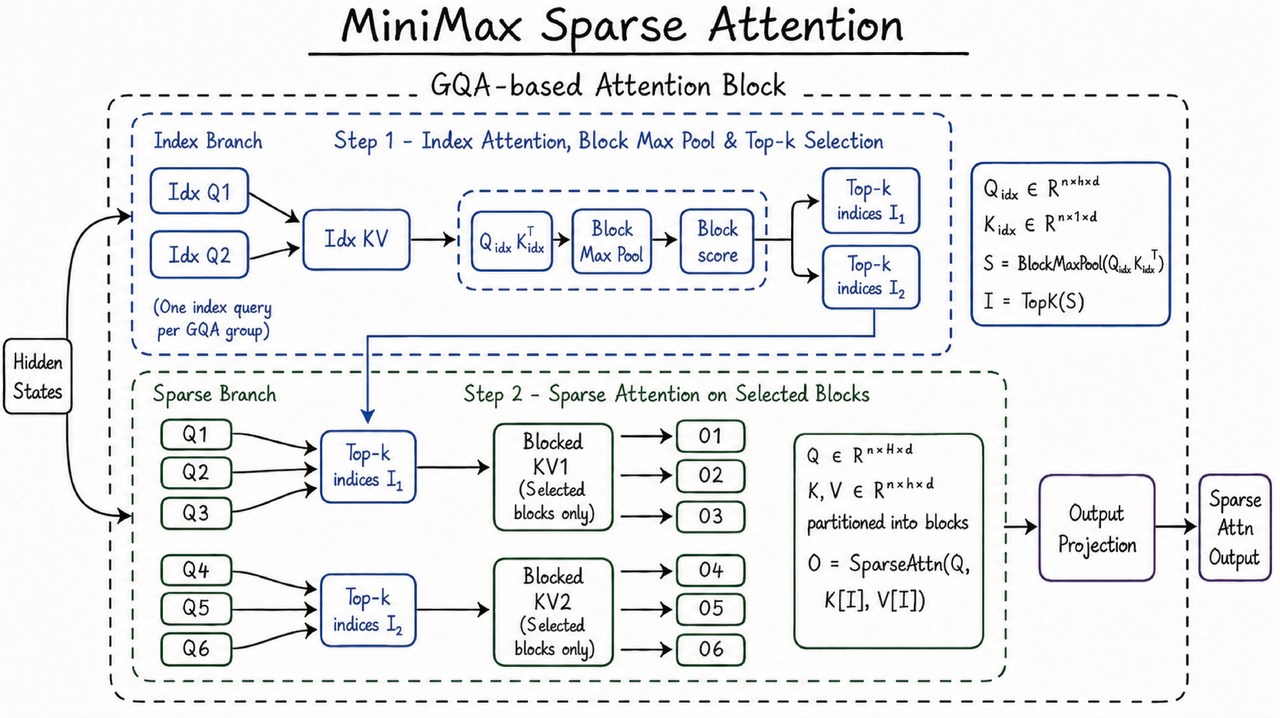
- 대용량 컨텍스트 창: 자체 개발한 MiniMax Sparse Attention (MSA) 아키텍처를 기반으로 API에서 최대 1M 토큰(백만 토큰)의 컨텍스트 창을 지원하며, 최소 512K 토큰은 사용 가능합니다. 이 백만 토큰 컨텍스트는 장거리 에이전트 구동, 장문 코딩, 그리고 긴 영상 이해를 위한 필수 인프라입니다.
- 네이티브 멀티모달: 모델 전체 데이터 파이프라인을 재구성하여 사전 학습 데이터 규모를 수백 테라바이트(T) 수준으로 확장했습니다. 제로 베이스부터 멀티모달 훈련을 진행함으로써, 텍스트와 시각적 의미 공간 간의 높은 정렬성을 확보했습니다.
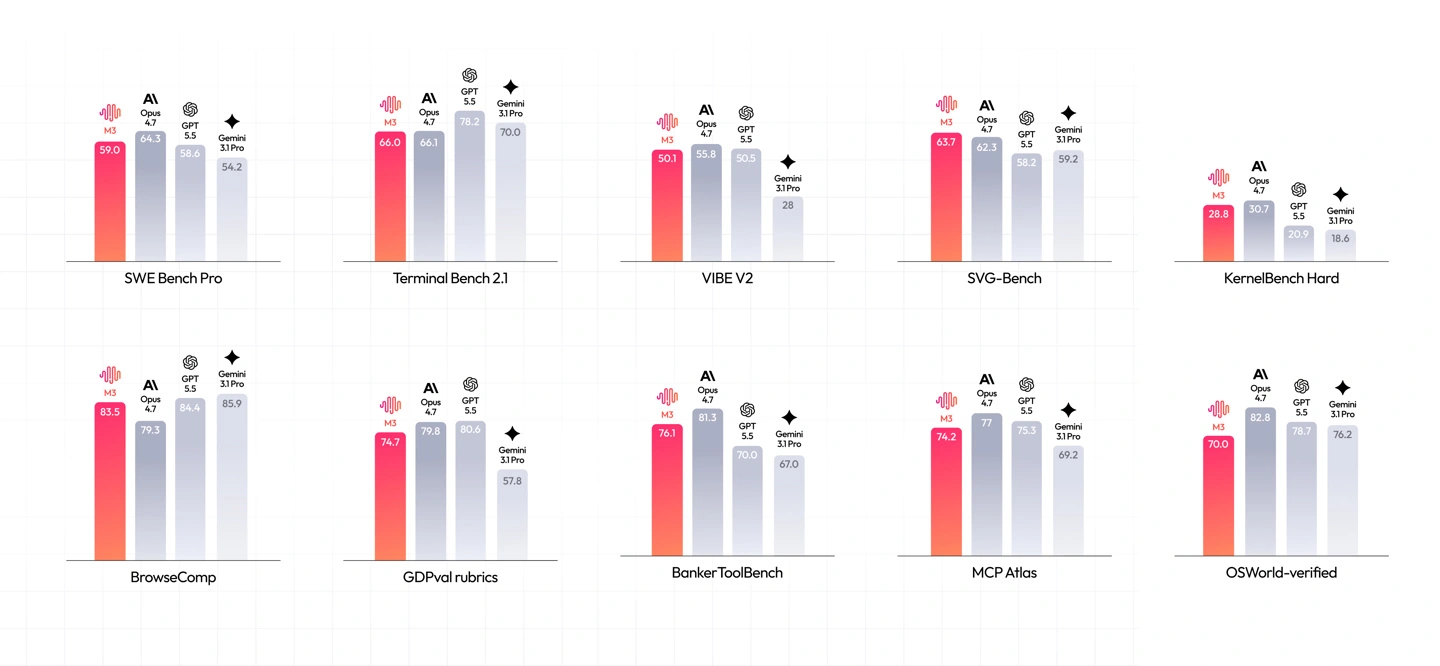
- 자율성 입증: BrowseComp 에이전트 평가에서 MiniMax M3는 Opus 4.7(79.3점)을 능가한 83.5점을 기록하며, 자율적인 웹 브라우징 및 정보 검색 능력을 과시했습니다.
실제 복합 작업 수행 능력
MiniMax M3는 코딩 SOTA(State-of-the-Art), 백만 컨텍스트 처리, 네이티브 멀티모달 기능을 동시에 구동할 수 있는 최초의 모델이라고 주장했습니다.
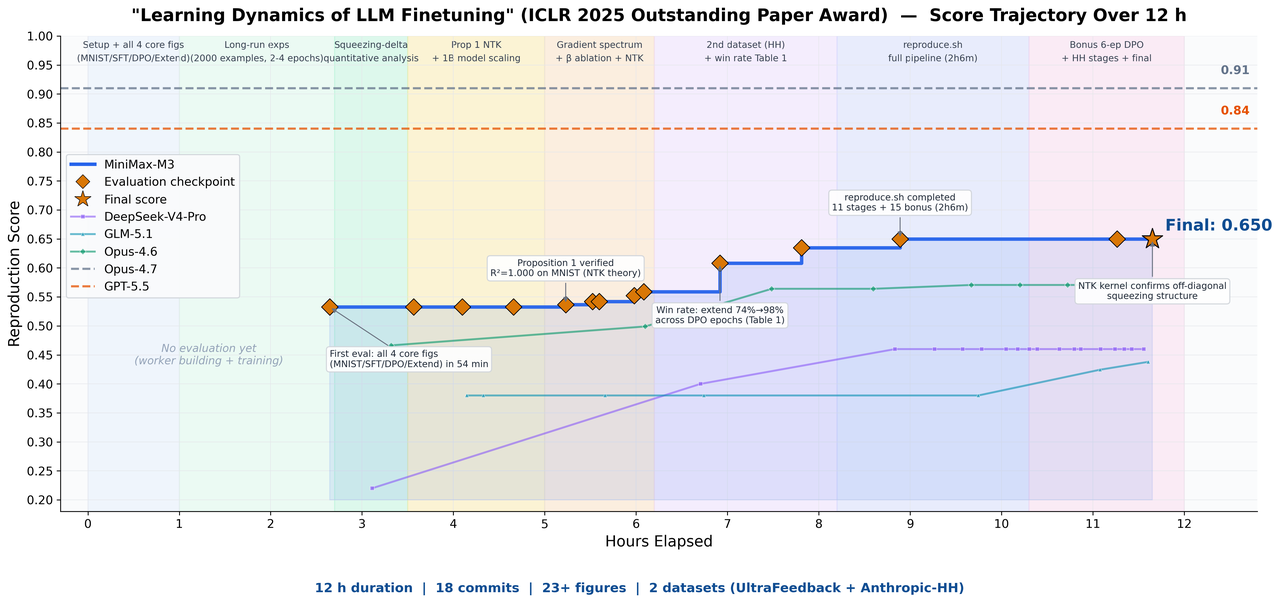
- 장시간 복합 실험: MiniMax 측은 M3에게 ICLR 2025 논문("Learning Dynamics of LLM Finetuning")을 제공하고 독립적인 재현 작업을 요청했습니다. M3는 약 12시간 동안 연속 구동하며, 자율적으로 18회의 커밋과 23개의 실험 차트를 생성하는 등 핵심 실험 과정을 성공적으로 수행했습니다.
- 멀티모달 및 장문 처리: 이 과정에서 모델은 논문의 표와 공식(수식)을 이해했으며, 긴 컨텍스트 창 덕분에 논문 원본, 코드, 실험 로그를 한 번에 입력받아 처리할 수 있었습니다. 이는 코딩 능력과 에이전트 능력이 결합된 장기적인 실행 흐름을 보여줍니다.
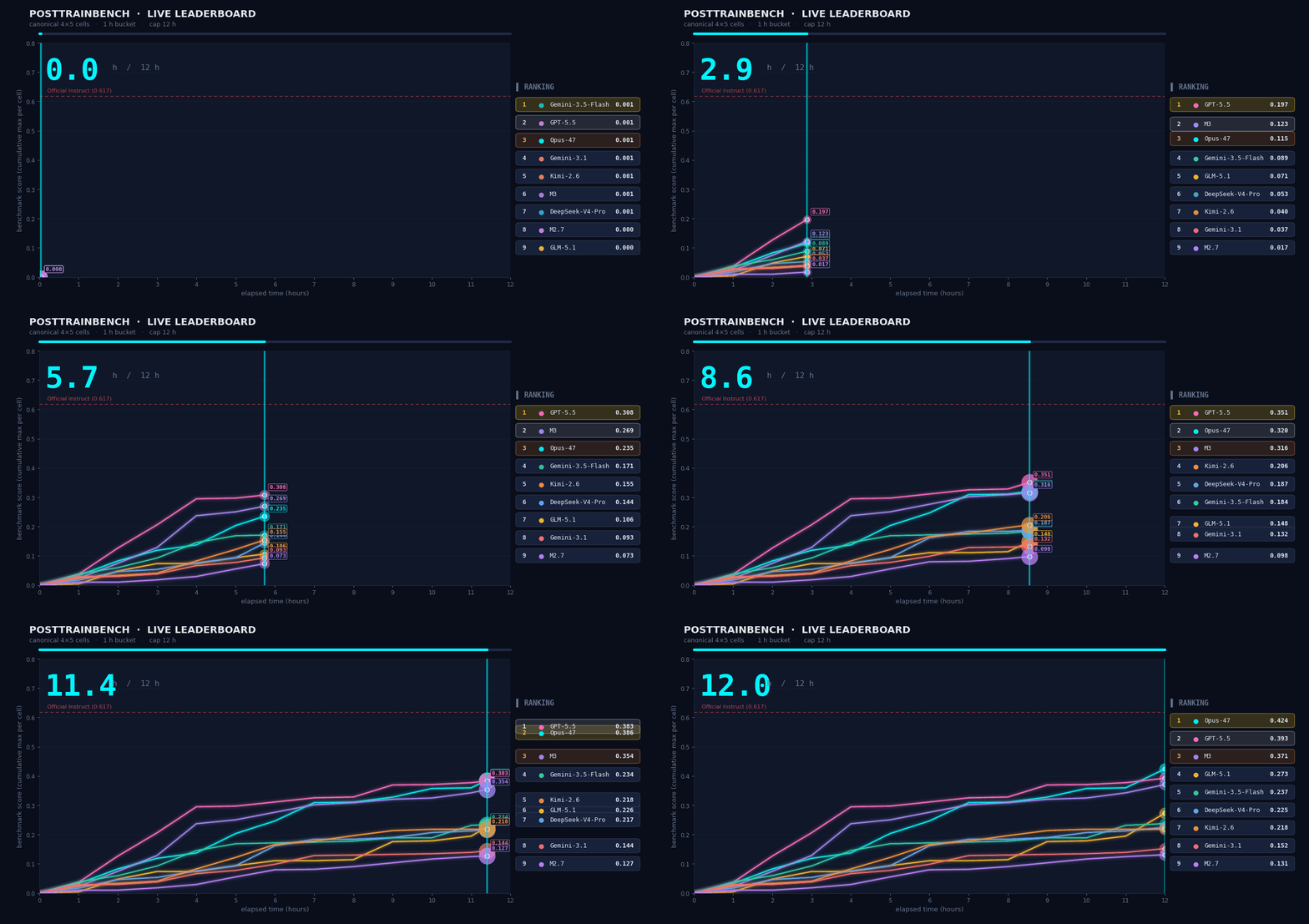
- 자율 학습 프로세스: M3에게 사전 훈련만 거친 기본 모델(Base Model) 네 개를 제공하고, 12시간 내에 데이터 합성, 훈련, 평가, 반복 개선의 전 과정을 자율적으로 완료하도록 요구했습니다. 이 과정에서 M3는 수학 추론, 코드 생성, 지식 질의응답 등의 임무 수행 능력을 갖추게 되었으며, 최종 점수는 37.1점으로 Opus 4.7(42.4점)과 GPT-5.5(39.3점)에 이어 3위를 차지했습니다.
기술적 구현 및 배포 정보
MiniMax는 M3의 API를 두 가지 버전으로 제공하며, 성능은 동일하지만 후자인 'M3-highspeed'가 더 빠른 속도를 자랑합니다.
- 캐싱 지원: 자동 캐시(Automatic Cache) 기능을 전면적으로 지원하여 별도의 설정 없이도 자동으로 적용됩니다.
- 오픈소스화 계획: MiniMax M3는 곧 HuggingFace와 GitHub에서 오픈소스로 공개될 예정이며, 사설 클러스터 배포 및 미세 조정(Fine-tuning)이 가능합니다.
API 가격 및 구독 플랜 변경 사항
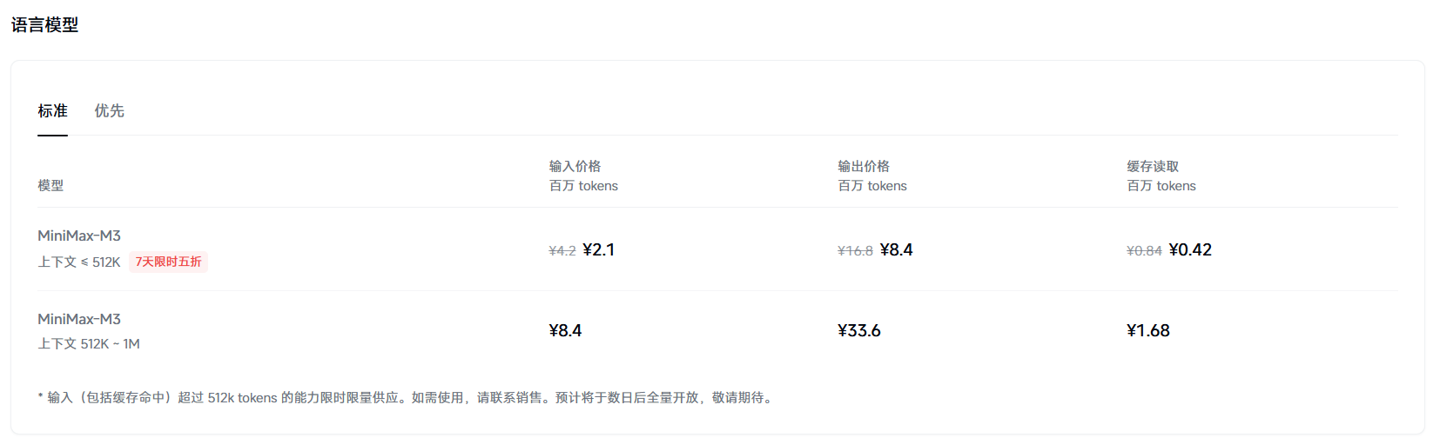
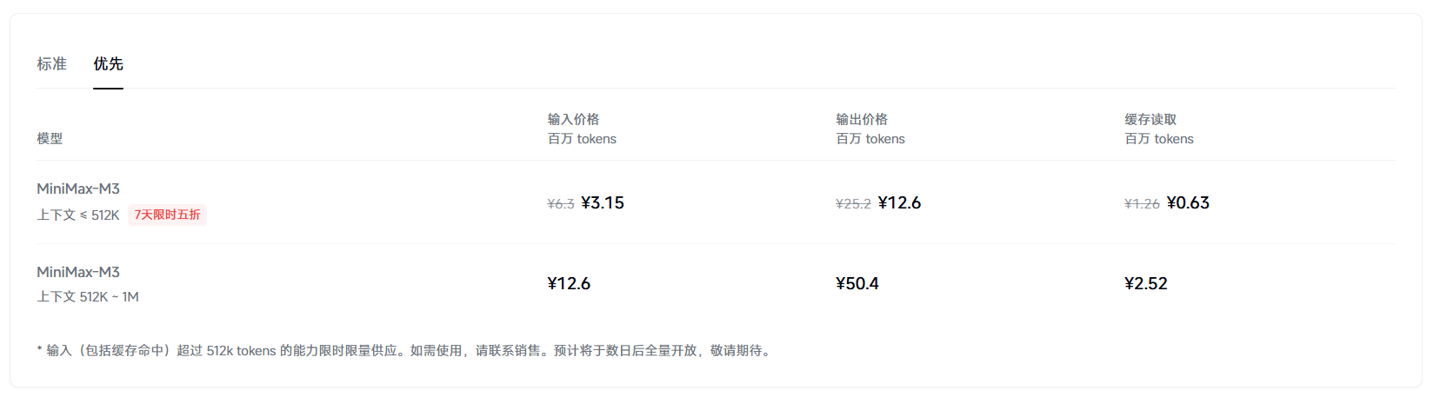
MiniMax M3 API의 컨텍스트가 512K 이하일 경우, 7일 동안 한시적으로 50% 할인된 요금이 적용됩니다.
- 입력(Input) 비용:
- 표준판: 2.1 위안 / 백만 토큰
- 우선판: 3.15 위안 / 백만 토큰
- 표준판: 8.4 위안 / 백만 토큰
- 우선판: 12.6 위안 / 백만 토큰
- 표준판: 0.42 위안 / 백만 토큰
- 우선판: 0.63 위안 / 백만 토큰
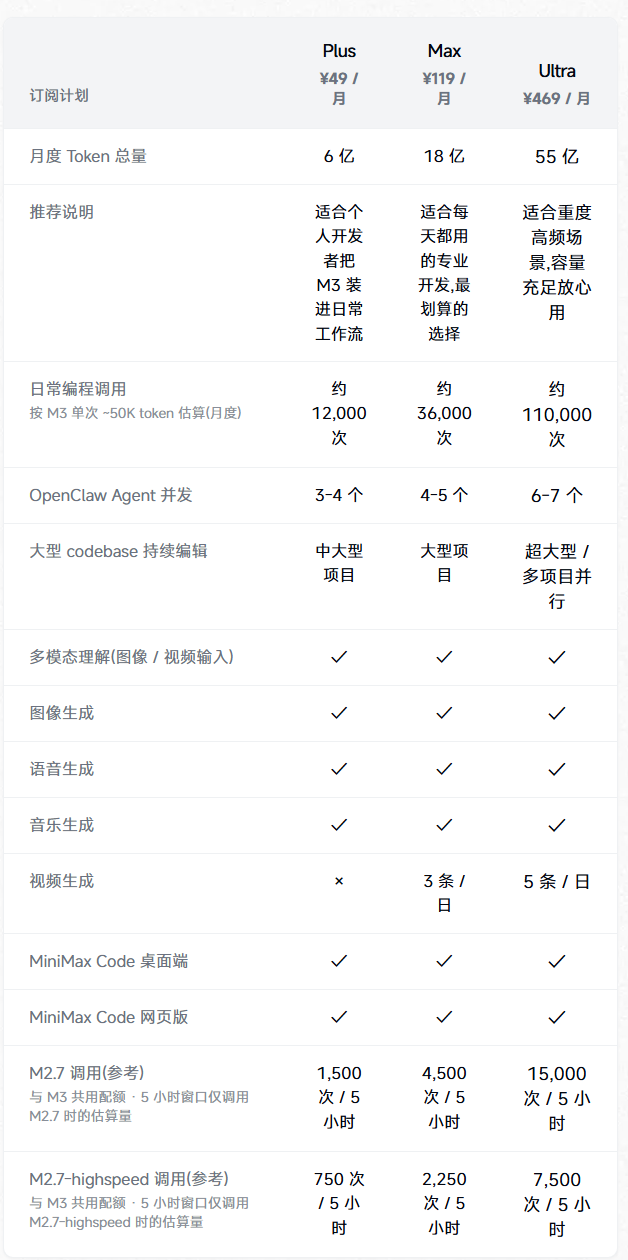
구독 플랜은 '토큰 플랜(Token Plan)' 기반의 사용량 차감 방식으로 업그레이드되었습니다. 현재 공개된 구독 등급은 Plus, Max, Ultra입니다.
- 차감 방식 변경: 기존의 고정 횟수 이해 방식에서 벗어나, 실제 자원 소모에 따라 포인트로 환산되어 차감됩니다. 간단한 작업은 적게, 복잡한 작업은 실제 사용량만큼 차감됩니다.
- 통합 할당량 풀(Unified Quota Pool): 토큰 플랜 범위 내의 모든 모델 사용량이 동일한 패키지 내 포인트 한도를 공유하며, 더 이상 기능별로 별도의 할당량을 분리하지 않습니다.
- 사용 현황 표시 개선: 대시보드에서 진행률 막대 형태로 현재 패키지의 포인트 한도와 소모 상황을 직관적으로 보여줍니다.
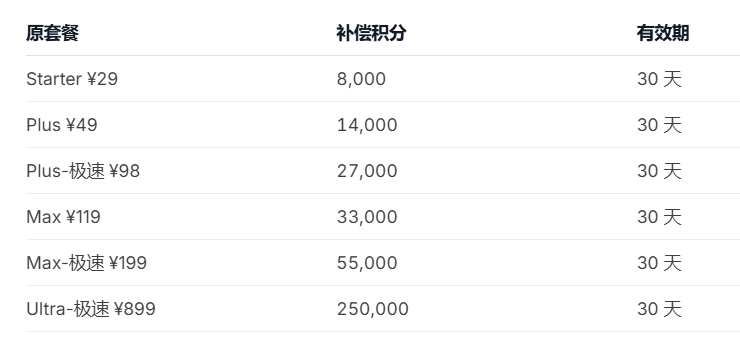
또한, 기존 사용자들을 위해 '마이그레이션 적응 보상'이 제공됩니다. 이전 플랜 사용자는 월간 풀 내에서 자유롭게 사용할 수 있었으나, 업그레이드 후에는 패키지 내 포인트 한도가 할당량 창으로 표시 및 통제되므로, 단기적으로는 사용 패턴에 적응할 필요가 있습니다.
총평
MiniMax M3는 백만 토큰 컨텍스트와 네이티브 멀티모달 기능을 통합하여 현존하는 AI 모델 중 가장 포괄적인 플래그십 성능을 보여주고 있습니다. 특히, 자율 에이전트 기능과 복잡한 과학 논문 재현 같은 실질적인 테스트를 통해 그 능력을 입증했습니다. 향후 오픈소스로 공개될 예정이므로, 개발자들에게 강력한 코딩 및 장기 컨텍스트 처리 솔루션을 제공할 것으로 기대됩니다.
产品定位与核心能力
MiniMax 正式推出 MiniMax M3 模型,宣称是首个同时具备“Frontier Coding & Agentic、百万上下文、原生多模态”三项能力的国产旗舰模型。该模型在编码与智能体评测中达到行业顶尖水平,具备自主任务拆解、工具调用与多步推理能力,生成的代码旨在直接交付。
技术规格与性能表现
MiniMax M3 基于自研 MiniMax Sparse Attention (MSA) 架构,在长文本处理和多模态对齐方面有显著提升:
- 上下文窗口:最高支持 1M tokens(保障至少 512K 可用)。
- 数据规模:预训练数据量级扩展至百 T。
- 评测表现:在 BrowseComp 智能体评测中获得 83.5 分,超越 Opus 4.7 的 79.3 分。
实战能力与模型版本
MiniMax M3 展示了强大的自主执行能力。在复现 ICLR 2025 论文实验时,模型在 12 小时内独立产出 18 次 commit 与 23 张图表;在自动化训练任务中,其得分位列第三(仅次于 Opus 4.7 和 GPT-5.5)。
官方提供 M3 和 M3-highspeed 两个版本 API,两者结果一致但后者速度更快,并支持自动 Cache 功能。
开源计划与定价信息
MiniMax M3 将在 HuggingFace 和 GitHub 上开源,支持私有集群部署和微调。针对上下文 ≤ 512K 的 API 提供限时五折优惠:
- 输入价格:标准版 2.1 元 / 百万 tokens,优先版 3.15 元 / 百万 tokens。
- 输出价格:标准版 8.4 元 / 百万 tokens,优先版 12.6 元 / 百万 tokens。
- 缓存读取:标准版 0.42 元 / 百万 tokens,优先版 0.63 元 / 百万 tokens。
总结
MiniMax M3 是具备百万上下文、原生多模态及强悍 Agent 能力的国产旗舰模型。它在复杂编码任务和自动化流程中表现卓越,并提供高性能 API 及开源支持。
MiniMax M3:100万トークンのコンテキストを備えた次世代フラッグシップモデル
IT之家の報道によると、MiniMaxは公式サイトを通じて新しいAIモデル「MiniMax M3」を発表しました。このモデルは、「フロンティア級のコーディングおよびエージェント機能」、「100万トークンのコンテキスト」、そして「ネイティブマルチモーダル」という3つの主要な能力を兼ね備えた国内フラッグシップモデルとして紹介されています。特に、完全な最先端(Frontier)機能をオープンな世界で初めて実装した点が強調されています。
核心技術とパフォーマンス
MiniMax M3は開発過程において、以下のような卓越した能力を示しました。
- コーディングおよびエージェント機能: コーディングとエージェントの評価において「業界最高水準」に達したと主張しており、自律的なタスク分解、ツール呼び出し、多段階推論能力を備えています。このモデルが生成するコードは単に動作するだけでなく、実際のデプロイが可能なレベルであることを強調しています。
- 大容量コンテキスト窓: 自社開発のMiniMax Sparse Attention (MSA) アーキテクチャに基づき、APIで最大1Mトークン(100万トークン)のコンテキスト窓をサポートし、最低でも512Kトークンは利用可能です。この100万トークンのコンテキストは、長距離エージェントの駆動、長文コーディング、および長い動画の理解に不可欠なインフラとなります。
- ネイティブマルチモーダル: モデル全体のデータパイプラインを再構築し、事前学習データの規模を数百テラバイト(T)レベルに拡張しました。ゼロベースからマルチモーダル学習を行うことで、テキストと視覚的な意味空間の間の高い整合性を確保しています。
- 自律性の実証: BrowseCompエージェント評価において、MiniMax M3はOpus 4.7(79.3点)を上回る83.5点を記録し、自律的なウェブブラウジングおよび情報検索能力を誇示しました。
実際の複合タスク遂行能力
MiniMax M3は、コーディングSOTA(State-of-the-Art)、100万コンテキスト処理、ネイティブマルチモーダル機能を同時に実行できる初のモデルであると主張しています。
- 長時間の複合実験: MiniMax側はM3にICLR 2025の論文("Learning Dynamics of LLM Finetuning")を提供し、独立した再現作業を要求しました。M3は約12時間にわたり連続稼働し、自律的に18回のコミットと23の実験チャートを生成するなど、主要な実験プロセスを成功裏に遂行しました。
- マルチモーダルおよび長文処理: この過程でモデルは論文内の表や数式を理解し、長いコンテキスト窓のおかげで、論文の原文、コード、実験ログを一度に入力して処理することができました。これはコーディング能力とエージェント能力が融合した長期的な実行フローを示しています。
- 自律学習プロセス: M3に対し、事前学習のみを終えた4つのベースモデル(Base Model)を提供し、12時間以内にデータ合成、トレーニング、評価、反復改善の全工程を自律的に完了するよう要求しました。この過程でM3は数学推論、コード生成、知識の質疑応答などの任務遂行能力を獲得し、最終スコアはOpus 4.7(42.4点)とGPT-5.5(39.3点)に次ぐ3位を獲得しました。
技術的実装および配布情報
MiniMaxはM3のAPIを2つのバージョンで提供しており、性能は同一ですが、後者の「M3-highspeed」の方がより高速な処理を誇ります。
- キャッシングのサポート: 自動キャッシュ(Automatic Cache)機能を全面的にサポートしており、特別な設定なしで自動的に適用されます。
- オープンソース化計画: MiniMax M3は間もなくHuggingFaceとGitHubでオープンソースとして公開される予定であり、プライベートクラスターでの展開や微調整(Fine-tuning)が可能です。
API価格およびサブスクリプションプランの変更
MiniMax M3 APIのコンテキストが512K以下の場合、7日間限定で50%割引された料金が適用されます。
- 入力(Input)コスト:
- 標準版:2.1 元 / 100万トークン
- 優先版:3.15 元 / 100万トークン
- 出力(Output)コスト:
- 標準版:8.4 元 / 100万トークン
- 優先版:12.6 元 / 100万トークン
- その他(キャッシュ等):
- 標準版:0.42 元 / 100万トークン
- 優先版:0.63 元 / 100万トークン
サブスクリプションプランは「トークンプラン(Token Plan)」に基づく使用量差し引き方式にアップグレードされました。現在公開されているサブスクリプションレベルはPlus、Max、Ultraです。
- 差し引き方法の変更: 従来の固定回数理解から脱却し、実際の資源消費に応じてポイントに換算され差し引かれます。単純なタスクは少なく、複雑なタスクは実際の使用量に応じて差し引かれます。
- 統合割当プール(Unified Quota Pool): トークンプランの範囲内にあるすべてのモデルの使用量は、同一パッケージ内のポイント制限を共有し、機能ごとに個別の割当を分けることはありません。
- 使用状況表示の改善: ダッシュボードで進行状況バーの形式で、現在のパッケージのポイント限度と消費状況を直感的に表示します。
また、既存ユーザー向けに「移行適応補償」が提供されます。以前のプラン利用者は月間プール内で自由に使用できましたが、アップグレード後はパッケージ内のポイント限度が割当窓として表示・管理されるため、短期的には使用パターンの適応が必要となります。
総評
MiniMax M3は、100万トークンのコンテキストとネイティブマルチモーダル機能を統合し、現存するAIモデルの中で最も包括的なフラッグシップ性能を示しています。特に、自律エージェント機能や複雑な科学論文の再現といった実質的なテストを通じてその能力を証明しました。今後オープンソースとして公開される予定であるため、開発者にとって強力なコーディングおよび長期コンテキスト処理ソリューションを提供することが期待されます。
まとめ
MiniMax M3は、100万トークンの広大なコンテキスト窓と高度なマルチモーダル機能を備えた最新のフラッグシップモデルです。自律的なエージェント機能や複雑な科学的推論において優れた性能を実証しており、今後オープンソースとして公開されることで開発者向けの強力なツールとなることが期待されます。
MiniMax M3: Next-Generation Flagship Model with One Million Token Context
According to IT News, MiniMax has unveiled its new AI model, MiniMax M3, via its official website. The model is introduced as a domestic flagship featuring three core capabilities: "frontier coding and agent functions," "one million token context," and "native multimodality." The company emphasizes that it is the first to implement full frontier features in an open world.
Core Technologies and Performance
During its development, MiniMax M3 demonstrated several outstanding capabilities:
- Coding and Agent Functions: Claiming to reach "industry-leading" levels in coding and agent evaluations, the model possesses autonomous task decomposition, tool calling, and multi-step reasoning capabilities. The company highlighted that the code generated by this model goes beyond mere functionality to be of a level suitable for actual deployment.
- Large Context Window: Based on the self-developed MiniMax Sparse Attention (MSA) architecture, it supports a context window of up to 1M tokens in its API, with at least 512K tokens available. This one million token context is essential infrastructure for long-range agent operation, long-form coding, and understanding long videos.
- Native Multimodal: The model's entire data pipeline was reconstructed, expanding the pre-training data scale to hundreds of Terabytes (T). By conducting multimodal training from a zero base, it achieved high alignment between text and visual meaning spaces.
- Proven Autonomy: In the BrowseComp agent evaluation, MiniMax M3 scored 83.5, surpassing Opus 4.7 (79.3), demonstrating its capabilities in autonomous web browsing and information retrieval.
Execution of Complex Tasks
MiniMax M3 is claimed to be the first model capable of simultaneously running SOTA coding, one million context processing, and native multimodal features.
- Long-duration Complex Experiments: MiniMax provided M3 with an ICLR 2025 paper ("Learning Dynamics of LLM Finetuning") and requested an independent reproduction task. M3 ran continuously for approximately 12 hours, successfully performing key experimental processes such as autonomously generating 18 commits and 23 experiment charts.
- Multimodal and Long-form Processing: During this process, the model understood tables and formulas in the paper. Thanks to the large context window, it could process the original paper, code, and experiment logs simultaneously. This demonstrates a long-term execution flow combining coding and agent capabilities.
- Autonomous Learning Process: M3 was provided with four base models that had only undergone pre-training and was tasked with completing data synthesis, training, evaluation, and iterative improvement within 12 hours. Through this process, M3 acquired capabilities in mathematical reasoning, code generation, and knowledge Q&A, ultimately ranking third behind Opus 4.7 (42.4) and GPT-5.5 (39.3) with a score of 37.1.
Technical Implementation and Deployment
MiniMax offers the M3 API in two versions; while performance is identical, "M3-highspeed" offers faster speeds.
- Caching Support: It fully supports Automatic Cache, which is applied automatically without additional configuration.
- Open Source Plans: MiniMax M3 will soon be released as open source on HuggingFace and GitHub, allowing for private cluster deployment and fine-tuning.
API Pricing and Subscription Plan Changes
For the MiniMax M3 API, a temporary 50% discount is applied for 7 days when the context is below 512K.
- Pricing Structure:
- Standard: 2.1 / Priority: 3.15
- Standard: 8.4 / Priority: 12.6
- Standard: 0.42 / Priority: 0.63
Additionally, a "Migration Adaptation Bonus" is provided for existing users. While previous plan users could use resources freely within a monthly pool, after upgrading, the points are displayed and controlled as an allotment window, requiring some adjustment to usage patterns in the short term.
Overall Review
MiniMax M3 demonstrates the most comprehensive flagship performance among current AI models by integrating a one million token context with native multimodal capabilities. It has proven its capabilities through practical tests such as autonomous agent functions and the reproduction of complex scientific papers. As it is scheduled to be released as open source, it is expected to provide developers with a powerful solution for coding and long-context processing.
Summary
MiniMax M3 is a new flagship AI model featuring a massive 1 million token context window, native multimodality, and advanced autonomous agent capabilities. It has demonstrated high proficiency in complex tasks like scientific paper reproduction and large-scale code generation. The model will soon be available as an open-source option on HuggingFace and GitHub for developers.
产品发布与核心能力
MiniMax 稀宇科技正式推出 MiniMax M3 模型。该模型被定位为首个集“Frontier Coding & Agentic(前沿编码与智能体)、百万上下文、原生多模态”三项能力于一体的国产旗舰模型,旨在提供可直接交付的代码以及强大的自主任务拆解和工具调用能力。
技术架构与性能表现
MiniMax M3 基于自研的 MiniMax Sparse Attention (MSA) 架构,在数据处理和多模态对齐方面进行了深度优化。其核心技术指标如下:
- 上下文窗口: API 最高支持 1M tokens,确保至少 512K tokens 可用,支持长程 Agent、长程 Coding 及长视频理解。
- 数据规模: 通过重构数据管线,将预训练数据量提升至百 T 量级。
- 评测表现: 在 BrowseComp 智能体评测中获得 83.5 分,超越 Opus 4.7 的 79.3 分。
实战能力验证
MiniMax M3 展示了极强的逻辑推理与自动化执行能力。在复现 ICLR 2025 论文实验时,模型在近 12 小时内自主产出 18 次 commit 与 23 张实验图表;在处理四个仅完成预训练的 Base 模型任务时,其最终得分为 37.1,位列行业前三。
发布计划与定价信息
MiniMax 提供 M3 和 M3-highspeed(高速度版本)两个 API 选项,并支持自动 Cache 功能。模型将于 HuggingFace 和 GitHub 开源,支持私有部署与微调。
针对上下文 ≤ 512K 的请求,提供 7 天限时五折优惠:
- 输入价格: 标准版 2.1 元/百万 tokens,优先版 3.15 元/百万 tokens。
- 输出价格: 标准版 8.4 元/百万 tokens,优先版 12.6 元/百万 tokens。
- 缓存读取: 标准版 0.42 元/百万 tokens,优先版 0.63 元/百万 tokens。
订阅体系调整
MiniMax 更新了 Token Plan 订阅模式,核心变化包括:
- 从固定次数计费转变为基于实际资源消耗的积分扣减。
- 建立统一额度池,不同模型共用同一套套餐内的积分。
- 为老用户提供迁移适应补偿,并提供更直观的用量进度条显示。
总结
MiniMax M3 是具备百万上下文、原生多模态及强悍智能体能力的国产旗舰模型,在编码和复杂推理任务中表现优异。该模型将支持多种 API 版本并计划开源,同时伴随订阅体系的优化以提供更灵活的资源消耗模式。
MiniMax M3:100万トークンのコンテキストを備えた次世代フラッグシップモデル
IT之家の報道によると、MiniMaxは公式サイトを通じて新しいAIモデル「MiniMax M3」を発表しました。このモデルは、「フロンティア・コーディングおよびエージェント機能」、「100万トークンのコンテキスト」、そして「ネイティブマルチモーダル」という3つの主要な能力を兼ね備えた国内フラッグシップモデルとして紹介されています。特に、完全な最先端(Frontier)機能をオープンな世界で初めて実装した点が強調されています。
主要技術と性能
MiniMax M3は開発過程において、以下のような独自の能力を披露しました。
- コーディングおよびエージェント機能: コーディングとエージェントの評価において「業界最高水準」に達したと主張しており、自律的なタスク分解、ツール呼び出し、多段階推論能力を備えています。このモデルが生成するコードは単に動作するだけでなく、実際のデプロイが可能なレベルであることが強調されています。
- 大容量コンテキスト窓: 自社開発のMiniMax Sparse Attention (MSA) アーキテクチャに基づき、APIで最大100万(1M)トークンのコンテキスト窓をサポートし、最小でも512Kトークンが利用可能です。この100万トークンのコンテキストは、長距離エージェントの駆動、長文コーディング、および長い動画の理解に不可欠なインフラとなります。
- ネイティブマルチモーダル: モデル全体のデータパイプラインを再構築し、事前学習データの規模を数百テラバイト(T)レベルまで拡張しました。ゼロベースからマルチモーダルのトレーニングを行うことで、テキストと視覚的な意味空間の間の高い整合性を確保しています。
- 自律性の実証: BrowseCompのエージェント評価において、MiniMax M3はOpus 4.7(79.3点)を上回る83.5点を記録し、自律的なウェブブラウジングおよび情報検索能力を誇示しました。
実際の複合タスク遂行能力
MiniMax M3は、コーディングSOTA(State-of-the-Art)、100万コンテキスト処理、ネイティブマルチモーダル機能を同時に実行できる初のモデルであると主張しています。
- 長時間の複合実験: MiniMax側はM3にICLR 2025の論文("Learning Dynamics of LLM Finetuning")を提供し、独立した再現作業を要求しました。M3は約12時間にわたり連続稼働し、自律的に18回のコミットと23の実験チャートを作成するなど、主要な実験プロセスを成功させました。
- マルチモーダルおよび長文処理: この過程でモデルは論文内の表や数式を理解し、広大なコンテキスト窓のおかげで、論文の原文、コード、実験ログを一括して入力・処理することができました。これはコーディング能力とエージェント能力が融合した長期的な実行フローを示しています。
- 自律学習プロセス: M3に事前学習のみを終えたベースモデル(Base Model)を4つ提供し、12時間以内にデータ合成、トレーニング、評価、反復改善の全工程を自律的に完了するよう要求しました。この過程でM3は数学推論、コード生成、知識に関する質疑応答などのタスク遂行能力を獲得し、最終スコアは37.1点を記録。Opus 4.7(42.4点)とGPT-5.5(39.3点)に次ぐ3位となりました。
技術的実装および配信情報
MiniMaxはM3のAPIを2つのバージョンで提供しており、性能は同一ですが、後者の「M3-highspeed」の方がより高速な速度を誇ります。
- キャッシング対応: 自動キャッシュ(Automatic Cache)機能を全面的に...
まとめ
MiniMaxが発表した「MiniMax M3」は、100万トークンの広大なコンテキストと高度なコーディング・エージェント能力を兼ね備えた次世代フラッグシップモデルです。ネイティブマルチモーダル対応や自律的なタスク遂行能力において高い性能を示しており、特に長時間の複雑な実験や自動学習プロセスにおいて優れた実用性を証明しています。
MiniMax M3: Next-Generation Flagship Model with One Million Token Context
According to IT Home, MiniMax has officially unveiled its new AI model, MiniMax M3, through its official website. The model is introduced as a domestic flagship featuring three core capabilities: "frontier coding and agent functions," "one million token context," and "native multimodal." It specifically highlights being the first to implement full frontier features in an open-world environment.
Core Technologies and Performance
During its development, MiniMax M3 demonstrated several unique capabilities:
- Coding and Agent Capabilities: The model claims to have reached "industry-leading" levels in coding and agent evaluations. It features autonomous task decomposition, tool calling, and multi-step reasoning. The code generated by this model is emphasized as being production-ready rather than just functional.
- Large Context Window: Based on the proprietary MiniMax Sparse Attention (MSA) architecture, it supports a context window of up to 1M tokens via API, with a minimum of 512K tokens available. This one million token context is considered essential infrastructure for long-range agent operations, extensive coding, and understanding long videos.
- Native Multimodal: The entire data pipeline was reconstructed, expanding the pre-training data scale to hundreds of Terabytes (T). By conducting multimodal training from a zero base, it achieved high alignment between text and visual semantic spaces.
- Proven Autonomy: In the BrowseComp agent evaluation, MiniMax M3 scored 83.5, surpassing Opus 4.7 (79.3), demonstrating superior autonomous web browsing and information retrieval capabilities.
Complex Task Execution Capabilities
MiniMax M3 claims to be the first model capable of simultaneously running SOTA coding, one million context processing, and native multimodal features.
- Long-duration Complex Experiments: MiniMax provided M3 with an ICLR 2025 paper ("Learning Dynamics of LLM Finetuning") and requested an independent reproduction task. Over a continuous period of approximately 12 hours, M3 successfully performed core experimental processes, including 18 commits and the generation of 23 experiment charts.
- Multimodal and Long Context Processing: During this process, the model understood tables and formulas within the paper. Thanks to the large context window, it could process the original paper, code, and experiment logs simultaneously, demonstrating a long-term execution flow where coding and agent capabilities are combined.
- Autonomous Learning Process: M3 was provided with four base models that had only undergone pre-training. Within 12 hours, it autonomously completed the entire process of data synthesis, training, evaluation, and iterative improvement. Through this, M3 acquired capabilities in mathematical reasoning, code generation, and knowledge Q&A, ultimately ranking third with a score of 37.1 (following Opus 4.7 at 42.4 and GPT-5.5 at 39.3).
Technical Implementation and Deployment
MiniMax offers the M3 API in two versions; while performance is identical, "M3-highspeed" provides faster speeds.
- Caching Support: Full support for Automatic Cache...
Summary
MiniMax M3 is a new flagship AI model featuring a 1 million token context window, native multimodal capabilities, and advanced coding and agent functions. It demonstrated significant autonomy in complex tasks, such as reproducing research papers and self-improving on base models within a 12-hour window. The model is available in two versions to provide users with options for high performance or increased speed.
产品发布与核心定位
MiniMax 官方推出 MiniMax M3 模型,宣称其是首个同时具备“Frontier Coding & Agentic”、“百万上下文”以及“原生多模态”三项能力的国产旗舰模型。该模型旨在提供高度自动化的任务处理能力,提供的代码目标为直接可交付。
技术规格与性能表现
MiniMax M3 基于自研的 MiniMax Sparse Attention (MSA) 架构,在数据管线上进行了大规模重构,显著提升了多模态对齐能力。
- 上下文窗口:最高支持 1M tokens,确保至少 512K tokens 可用。
- 预训练规模:扩展至百 T 量级。
- 评测表现:在 BrowseComp 智能体评测中获得 83.5 分,超越 Opus 4.7 的 79.3 分。
实战能力与实验验证
MiniMax M3 展示了强大的自主任务拆解、工具调用和多步推理能力。在针对 ICLR 2025 论文的复现测试中,模型在近 12 小时内独立产出 18 次 commit 与 23 张实验图表;在自动化数据合成与训练流程中,其最终得分位列第三(仅次于 Opus 4.7 和 GPT-5.5)。
部署计划与定价政策
MiniMax 提供 M3 及追求速度的 M3-highspeed 两个版本,并支持自动 Cache 功能。该模型即将在 HuggingFace 和 GitHub 上开源,支持私有集群部署和微调。
- 限时优惠:针对上下文 ≤ 512K 的请求,提供 7 天限时五折优惠。
- 标准版价格:输入 2.1 元/百万 tokens,输出 8.4 元/百万 tokens,缓存读取 0.42 元/百万 tokens。
- 优先版价格:输入 3.15 元/百万 tokens,输出 12.6 元/百万 tokens,缓存读取 0.63 元/百万 tokens。
订阅体系调整
MiniMax 更新了 Token Plan 订阅模式,由固定次数改为基于积分的用量扣减。新政策包含统一的额度池、更直观的用量进度条展示,并为老用户提供迁移适应补偿。
总结
MiniMax M3 是具备百万上下文、原生多模态及强悍 Agent 能力的国产旗舰模型,在代码生成和复杂任务处理上表现优异。该模型将支持多种部署模式并提供多样化的 API 计费选项,旨在为开发者提供更高效的生产力工具。
MiniMax M3:100万トークンのコンテキストを備えた次世代フラッグシップモデル
ITの専門メディア「IT之家」の報道によると、MiniMaxは公式サイトを通じて最新のAIモデル「MiniMax M3」を発表しました。このモデルは、「フロンティア級のコーディングおよびエージェント機能」、「100万トークンのコンテキスト」、そして「ネイティブマルチモーール」という3つの主要な能力を兼ね備えた国内フラッグシップモデルとして位置付けられています。特に、最先端(Frontier)の機能をオープンな環境で初めて実装した点が強調されています。
核心技術とパフォーマンス
MiniMax M3は開発過程において、以下の卓越した能力を実証しました。
- コーディングおよびエージェント機能: コーディングとエージェントの評価において「業界最高水準」に達しており、自律的なタスク分解、ツール呼び出し、多段階推論能力を備えています。生成されるコードは単に動作するだけでなく、実際のデプロイが可能なレベルであることが強調されています。
- 大容量コンテキスト窓: 自社開発のMiniMax Sparse Attention (MSA) アーキテクチャに基づき、APIで最大1Mトークン(100万トークン)のコンテキスト窓をサポートし、最低でも512Kトークンは利用可能です。この広大なコンテキストは、長距離エージェントの駆動、長文コーディング、および長尺動画の理解に不可欠なインフラとなります。
- ネイティブマルチモーダル: モデル全体のデータパイプラインを再構築し、事前学習データの規模を数百テラバイト(T)レベルに拡張しました。ゼロベースからマルチモーダル学習を行うことで、テキストと視覚的な意味空間の間の高い整合性を確保しています。
- 自律性の実証: BrowseCompエージェント評価において、MiniX M3はOpus 4.7(79.3点)を上回る83.5点を記録し、自律的なウェブブラウジングおよび情報検索能力を証明しました。
実際の複合タスク遂行能力
MiniMax M3は、コーディングSOTA(State-of-the-Art)、100万コンテキスト処理、ネイティブマルチモーダル機能を同時に実行できる初のモデルであると主張しています。
- 長時間の複合実験: MiniMax側はM3にICLR 2025の論文("Learning Dynamics of LLM Finetuning")を提供し、独立した再現作業を要求しました。M3は約12時間にわたり連続稼働し、自律的に18回のコミットと23の実験チャートを生成するなど、主要な実験プロセスを成功裏に遂行しました。
- マルチモーダルおよび長文処理: この過程でモデルは論文内の表や数式を理解し、長いコンテキスト窓のおかげで、論文の原文、コード、実験ログを一度に入力して処理することができました。これはコーディング能力とエージェント能力が融合した長期的な実行フローを示しています。
- 自律学習プロセス: M3に対し、事前学習のみを終えた4つのベースモデル(Base Model)を提供し、12時間以内に出力・評価・改善の全工程を自律的に完了するよう要求しました。この過程でM3は数学推論、コード生成、知識の質疑応答などの能力を獲得し、最終スコアはOpus 4.7やGPT-5.5に次ぐ第3位を記録しました。
技術的な実装と展開情報
MiniMaxはM3のAPIを2つのバージョンで提供しており、性能は同一ですが「M3-highspeed」の方が高速な処理が可能です。
- キャッシュ対応: 自動キャッシュ(Automatic Cache)機能を全面的にサポートしており、特別な設定なしで自動適用されます。
- オープンソース化の計画: MiniMax M3は近日中にHuggingFaceおよびGitHubで公開される予定であり、プライベートクラスターでの展開や微調整(Fine-tuning)が可能です。
API価格およびサブスクリプションプランの変更
MiniMax M3 APIにおいて、コンテキストが512K以下の場合は7日間限定で50%割引が適用されます。
- 費用体系(100万トークンあたり):
- 入力(Input): 標準版 2.1元 / 優先版 3.15元
- 出力(Output): 標準版 8.4元 / 優先版 12.6元
- キャッシュ読み取り: 標準版 0.42元 / 優先版 0.63元
- サブスクリプションの刷新: 「トークンプラン(Token Plan)」に基づく使用量差し引き方式にアップグレードされました。提供されるランクはPlus、Max、Ultraです。
- 差し引き方法の変更: 固定回数の概念から、実際の資源消費量に応じてポイントとして換算・差し引かれる仕組みに変更されました。
- 統合割り当てプール: 特定の機能ごとに割当を分けるのではなく、パッケージ内のポイント枠をすべてのモデルで共有します。
まとめ
MiniMax M3は、100万トークンのコンテキストとネイティブマルチモーダルの機能を統合した、非常に強力な国内フラッグシップモデルです。特にコーディングやエージェント機能において高い性能を示しており、複雑な論文の再現実験など実用的なタスクでの能力が証明されています。今後、オープンソースとしての公開も予定されており、開発者にとって高度なコーディングや長文処理に最適なソリューションとなることが期待されます。
MiniMax M3: Next-Generation Flagship Model with One Million Token Context
According to IT Home, MiniMax has officially unveiled its new AI model, MiniMax M3. The model is introduced as a domestic flagship featuring three core capabilities: "Frontier Coding and Agentic" functions, a one-million token context window, and native multimodality. It is highlighted as the first to implement full frontier features in an open environment.
Core Technology and Performance
During its development, MiniMax M3 demonstrated several standout capabilities:
- Coding and Agent Functions: The model claims to reach "industry-leading" levels in coding and agent evaluations. It features autonomous task decomposition, tool calling, and multi-step reasoning. The code generated by the model is designed for actual deployment rather than just basic functionality.
- Large Context Window: Based on the self-developed MiniMax Sparse Attention (MSA) architecture, the API supports a context window of up to 1M tokens, with at least 512K tokens available for use. This massive context is essential for long-range agent operation, long-form coding, and understanding long videos.
- Native Multimodal: The entire data pipeline was reconstructed, expanding the pre-training data scale to hundreds of terabytes (T). By training from a zero base, the model achieved high alignment between text and visual semantic spaces.
- Proven Autonomy: In BrowseComp agent evaluations, MiniMax M3 scored 83.5 points, surpassing Opus 4.7's score of 79.3, demonstrating superior autonomous web browsing and information retrieval capabilities.
Complex Task Execution Capabilities
MiniMax M3 is touted as the first model capable of simultaneously running SOTA coding, one-million context processing, and native multimodality.
- Long-duration Complex Experiments: MiniMax provided M3 with an ICLR 2025 paper ("Learning Dynamics of LLM Finetuning") and requested an independent reproduction task. Over a continuous 12-hour run, M3 successfully executed key experimental processes, autonomously generating 18 commits and 23 experimental charts.
- Multimodal and Long-form Processing: During this process, the model understood tables and formulas within the paper. Thanks to the large context window, it could process the original paper, code, and experiment logs simultaneously, showcasing a long-term execution flow combining coding and agent capabilities.
- Autonomous Learning Process: M3 was provided with four base models that had only undergone pre-training. Within 12 hours, it autonomously completed the entire cycle of data synthesis, training, evaluation, and iterative improvement. It achieved high performance in mathematical reasoning, code generation, and knowledge Q&A, ranking third overall behind Opus 4.7 and GPT-5.5.
Technical Implementation and Deployment
MiniMax offers the M3 API in two versions: M3 and M3-highspeed. While both provide identical results, M3-highspeed offers faster processing speeds and supports automatic caching.
- Open Source Plans: MiniMax M3 will soon be released as open source on HuggingFace and GitHub, supporting private cluster deployment and fine-tuning.
- Pricing and Subscription Changes: A limited 50% discount is offered for 7 days for contexts under 512K.
- Input Costs: Standard: 2.1 RMB / million tokens; Priority: 3.15 RMB / million tokens.
- Output Costs: Standard: 8.4 RMB / million tokens; Priority: 12.6 RMB / million tokens.
- Cache Read: Standard: 0.42 RMB / million tokens; Priority: 0.63 RMB / million tokens.
- Deduction Method: Instead of fixed counts, points are deducted based on actual resource consumption. Simple tasks consume fewer points, while complex tasks scale accordingly.
- Unified Quota Pool: All models within a token plan share the same point limit in one package, removing separate quotas for different features.
- Improved Status Display: The dashboard now shows progress bars to provide an intuitive view of remaining points and consumption.
Subscription plans have been upgraded to a "Token Plan" based on usage deduction. The available tiers are Plus, Max, and Ultra.
Summary
MiniMax M3 is a flagship AI model that integrates a one-million token context window, native multimodality, and advanced agentic capabilities. It has proven its ability in complex tasks like reproducing scientific papers and autonomous learning while offering high-performance API options and upcoming open-source support.