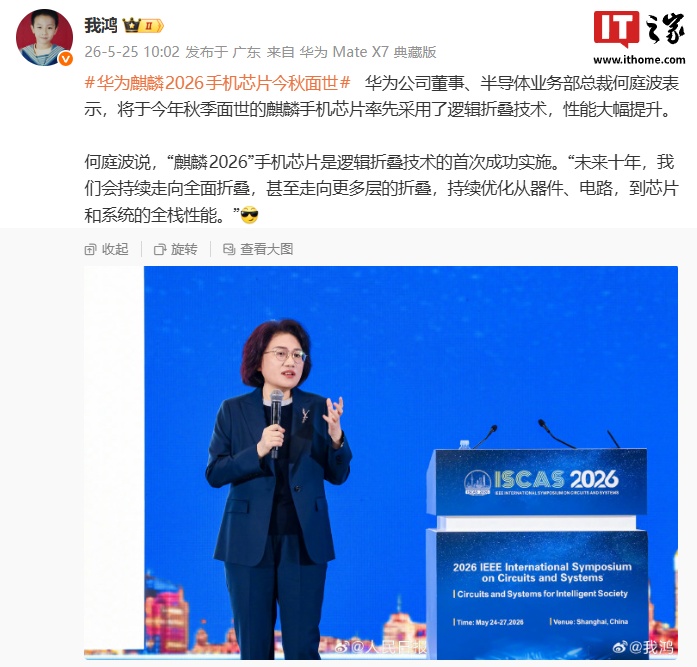
Huawei의 차세대 칩 기술 발표: 논리적 폴딩 기술 도입
IT之家에 따르면, Huawei는 국제 회로 및 시스템 학회(ISCAS 2026)에서 중요한 기술 혁신을 예고했습니다. 이 자리에서 Huawei 임원 겸 반도체 사업부 총괄인 He Tingbo는 올해 가을 출시될 Kirin 스마트폰 칩이 '논리적 폴딩 기술(Logical Folding Technology)'을 최초로 적용하여 성능을 대폭 향상시킬 것이라고 밝혔습니다.
기술 혁신 로드맵: 전면적인 적층 구조 지향
He Tingbo는 "Kirin 2026" 스마트폰 칩이 논리적 폴딩 기술의 최초 성공 사례임을 강조했습니다. 그녀는 또한 "향후 10년 동안 우리는 완전한 폴더블(folding) 구조를 넘어, 더 많은 레이어를 쌓는 방향으로 나아가며, 소자, 회로, 칩 및 시스템 전반에 걸친 스택 성능을 지속적으로 최적화할 것"이라고 설명했습니다.
모어의 법칙에서 '타우 법칙'으로의 패러다임 전환
Huawei가 제시한 기술 변화는 기존 반도체 발전의 개념을 근본적으로 바꿉니다. 전통적인 모어의 법칙이 벽돌(트랜지스터) 크기를 줄여 같은 면적에 더 많은 트랜지스터를 채워 넣는 방식이었다면, 현재는 물리적 한계에 도달했습니다.
이에 대안으로 Huawei가 제시한 '타우 법칙(Tau Law)'은 접근 방식을 바꿉니다. 이는 평평한 구조(단층)를 아파트 건물처럼 여러 층으로 쌓아 올려 성능을 끌어올리는 방식입니다.
향후 전망 및 예상 모델
현재 Huawei 측은 'Kirin 2026' 칩에 대한 구체적인 정보는 공개하지 않았으며, IT之家는 관련 소식을 지속적으로 추적할 예정입니다. 다만, Huawei의 역대 신제품 출시 주기를 고려했을 때, Mate 90 시리즈가 이 새로운 플래그십 칩을 최초로 탑재하여 선보일 가능성이 높다고 예측하고 있습니다.
총평
Huawei는 차세대 Kirin 칩에 논리적 폴딩 기술을 적용하며 반도체 성능 향상의 패러다임을 '크기 축소'에서 '구조 적층 및 최적화'로 전환하고 있습니다. 이는 기존 모어의 법칙의 한계를 극복하려는 시도로, 스마트폰 프로세서가 단순한 평면 구조를 넘어 다층적인 복합 구조를 갖게 됨을 의미합니다. 이러한 기술 발전은 향후 Huawei의 플래그십 모델에 혁신적인 성능 개선을 가져올 것으로 기대됩니다.麒麟 2026 芯片与逻辑折叠技术
Huawei 在 ISCAS 2026 上宣布,将于今年秋季推出的“麒麟 2026”手机芯片将首次采用逻辑折叠技术。该技术的应用旨在突破当前晶体管尺寸接近物理极限的挑战,从而大幅提升芯片性能。
从摩尔定律到“韬(τ)定律”
为了应对传统摩尔定律面临的瓶颈,Huawei 发布了“韬(τ)定律”。两者的核心逻辑差异如下:
- 摩尔定律:通过缩小晶体管尺寸(如将砖块变小),在相同面积内塞入更多晶体管。
- 韬(τ)定律:通过逻辑折叠技术,将“平房”结构转变为多层“楼房”结构,从而优化从器件、电路到芯片和系统的全栈性能。
未来规划与产品预测
Huawei 计划在未来十年持续推进全面折叠及更多层的折叠技术。相关关键信息如下:
- 技术目标: 预计到 2031 年,基于韬定律的高端芯片晶体管密度将达到 1.4 纳米制程的同等水平。
- 首发产品: 根据以往发布节奏,该款新芯片预计将首发搭载于 Mate 90 系列手机。
总结
Huawei 将于今年秋季推出采用逻辑折叠技术的“麒麟 2026”芯片,并提出旨在突破物理限制的“韬(τ)定律”。该技术通过多层结构优化性能,预计到 2031 年可达到 1.4 纳米制程的晶体管密度。此项创新技术有望在 Mate 90 系列中首发。
Huaweiの次世代チップ技術発表:論理的フォールディング技術の導入
IT之家の報道によると、Huaweiは国際回路・システム学会(ISCAS 2026)において重要な技術革新を発表しました。この場において、Huaweiの幹部兼半導体事業部門責任者のHe Tingbo氏は、今秋にリリースされるKirinスマートフォンチップに「論理的フォールディング技術(Logical Folding Technology)」を初めて採用し、性能を大幅に向上させると明らかにしました。
技術革新のロードマップ:全面的な積層構造への移行
He Tingbo氏は、「Kirin 2026」スマートフォンチップが論理的フォールディング技術の最初の成功例であることを強調しました。彼女はさらに、今後の展望について次のように述べています。
- 今後10年間、単なる折りたたみ(folding)構造を超え、より多くのレイヤーを積み上げる方向へ進む。
- デバイス、回路、チップ、およびシステム全体におけるスタック性能を継続的に最適化する。
ムーアの法則から「タウの法則」へのパラダイムシフト
Huaweiが提示した技術的な変化は、従来の半導体発展の概念を根本から変えるものです。従来のムーアの法則は、トランジスタのサイズを縮小して同じ面積により多くのトランジスタを詰め込む手法でしたが、現在は物理的な限界に達しています。
これに対する代替案としてHuaweiが提示した「タウの法則(Tau Law)」は、アプローチを根本から変えるものです。これは平面構造(単層)をマンションのように多層に積み上げることで性能を引き上げる手法です。
今後の展望と予想モデル
現在、Huawei側は「Kirin 2026」チップに関する具体的な情報は公開していません。IT之家は関連情報を継続的に追跡する予定です。しかし、Huaweiの過去の新製品リリースサイクルを考慮すると、Mate 90シリーズがこの新しいフラッグシップチップを初搭載して登場する可能性が高いと予測されています。
まとめ
Huaweiは次世代Kirinチップに「論理的フォールディング技術」を採用することで、半導体性能向上のパラダイムを「サイズの縮小」から「構造の積層と最適化」へと転換します。これはムーアの法則の限界を克服するための試みであり、スマートフォンプロセッサが多層的な複合構造を持つことで、将来のフラッグシップモデルに革新的な性能向上をもたらすことが期待されます。
Huawei Announces Next-Generation Chip Technology: Introduction of Logical Folding
According to IT之家, Huawei announced a significant technological innovation at the International Symposium on Circuits and Systems (ISCAS 2026). He Tingbo, a Huawei executive and head of the semiconductor division, revealed that Kirin smartphone chips scheduled for release this fall will be the first to implement "Logical Folding Technology" to significantly enhance performance.
Innovation Roadmap: Aiming for Comprehensive Stacking Structures
He Tingbo emphasized that the "Kirin 2026" smartphone chip marks the first successful implementation of Logical Folding technology. She explained that over the next decade, the company intends to move beyond simple folding structures toward stacking more layers, continuously optimizing stack performance across devices, circuits, chips, and systems.
Paradigm Shift from Moore's Law to "Tau Law"
The technological shift presented by Huawei fundamentally changes the traditional concept of semiconductor development. While traditional Moore's Law focused on shrinking transistor sizes to pack more components into a given area, it has reached its physical limits.
As an alternative, the "Tau Law" proposed by Huawei shifts this approach. Instead of relying on flat structures (single layers), it builds performance by stacking multiple layers, similar to how apartment buildings are constructed vertically.
Future Outlook and Expected Models
Currently, Huawei has not disclosed specific details regarding the "Kirin 2026" chip, and IT之家 will continue to monitor related news. However, based on Huawei's historical product release cycles, it is highly likely that the Mate 90 series will be the first to feature this new flagship chip.
Summary
Huawei is shifting its semiconductor development paradigm from "size reduction" to "structural stacking and optimization" by introducing Logical Folding technology in its next-generation Kirin chips. This approach aims to overcome the physical limitations of Moore's Law by utilizing multi-layered complex structures. These advancements are expected to deliver significant performance improvements for Huawei's upcoming flagship smartphone models.
麒麟 2026 芯片与逻辑折叠技术
Huawei 将于今年秋季推出“麒麟 2026”手机芯片。该芯片是逻辑折叠技术的首次成功实施,旨在通过该技术显著提升芯片的性能。
“韬定律”对摩尔定律的突破
针对当前晶体管尺寸接近物理极限的现状,Huawei 推出了“韬(τ)定律”。与传统摩尔定律通过缩小晶体管尺寸来增加密度不同,“韬定律”通过逻辑折叠改变结构设计以提升性能。
技术路线与未来展望
Huawei 计划在未来十年内持续推动全栈性能优化,涵盖从器件、电路到芯片和系统的多个层面。相关预测如下:
- 预计到 2031 年,基于“韬定律”的高端芯片晶体管密度将达到 1.4 纳米制程的同等水平。
- Mate 90 系列手机有望成为首发搭载该款新芯片的机型。
总结
Huawei 将于今年秋季推出采用逻辑折叠技术的“麒麟 2026”芯片,并提出旨在突破物理极限的“韬定律”。该技术路线通过结构优化而非单纯缩小尺寸来提升性能,预计到 2031 年将达到 1.4 纳米制程的晶体管密度水平。
Huaweiの次世代チップ技術発表:論理的フォールディング技術の導入
IT之家の報道によると、Huaweiは国際回路・システム学会(ISCAS 2026)において重要な技術革新を発表しました。この場において、Huaweiの幹部で半導体事業部門の責任者であるHe Tingbo氏は、今秋にリリースされるKirinスマートフォンチップに「論理的フォールディング技術(Logical Folding Technology)」を初めて採用し、性能を大幅に向上させると明らかにしました。この技術は、トランジスタのサイズが物理的な限界に近づいている現状の課題を克服することを目的としています。
モアの法則から「タウ(τ)法則」へのパラダイムシフト
Huaweiが提示した技術革新は、従来の半導体発展の概念を根本から変えるものです。従来の「モアの法則」は、トランジスタのサイズを縮小することで同じ面積により多くのトランジスタを詰め込む手法でしたが、現在は物理的な限界に達しています。
これに対する代替案としてHuaweiが提示したのが「タウ(τ)法則」です。両者の核心的な論理の違いは以下の通りです。
- モアの法則: トランジスタのサイズを縮小する(例:レンガを小さくする)ことで、同じ面積内に多くのトランジスタを詰め込む。
- タウ(τ)法則: 論理的フォールディング技術により、「平屋」構造を多層の「ビル」のような構造へと転換し、デバイス、回路、チップ、システムに至るまでの全層の性能を最適化する。
今後の展望と予測されるモデル
Huaweiは今後10年間にわたり、完全なフォールディング構造およびさらなる積層技術を継続的に推進する計画です。関連する主要な情報は以下の通りです。
- 技術目標: 2031年までに、タウ(τ)法則に基づくハイエンドチップのトランジスタ密度を、1.4nmプロセスと同等のレベルまで引き上げることを目指します。
- 初登場製品: これまでの発表サイクルに基づくと、この新しいチップはMate 90シリーズに初めて搭載される可能性が高いと予測されています。
まとめ
Huaweiは次世代Kirinチップに「論理的フォールディング技術」を導入し、半導体性能の向上におけるパラダイムを「微細化」から「構造の積層と最適化」へと転換します。この「タウ(τ)法則」により2031年までに1.4nmプロセスに匹敵する密度を実現することを目指しており、Mate 90シリーズでの初搭載が期待されています。
Huawei Announces Next-Generation Chip Technology: Introduction of Logical Folding
According to IT Home, Huawei announced significant technological innovations at the International Symposium on Circuits and Systems (ISCAS 2026). He Tingbo, a Huawei executive and head of the semiconductor division, revealed that the Kirin smartphone chip set to launch this fall will be the first to implement "Logical Folding Technology" to significantly boost performance.
Innovation Roadmap: Moving Toward Full Stacked Architecture
He Tingbo emphasized that the "Kirin 2026" smartphone chip represents the first successful implementation of logical folding technology. She explained that over the next decade, Huawei aims to move beyond simple folded structures toward stacking more layers, continuously optimizing performance across devices, circuits, chips, and entire systems.
Paradigm Shift: From Moore's Law to "Tau ($ au$) Law"
The technological shift proposed by Huawei fundamentally changes the concept of semiconductor evolution. While traditional Moore's Law focused on shrinking transistor sizes (the "bricks") to fit more into a given area, it has reached physical limitations.
As an alternative, Huawei introduced the "Tau ($ au$) Law." This approach shifts the focus from flat structures (single-story houses) to multi-layered structures (multi-story buildings), thereby enhancing performance through logical folding.
Future Outlook and Expected Models
While specific details regarding the "Kirin 2026" chip have not been fully disclosed, IT Home will continue to track updates. Based on Huawei's historical release cycles, it is highly anticipated that the Mate 90 series will be the first flagship model to feature this new processor.
- Technical Goal: By 2031, high-end chips based on Tau Law are expected to reach transistor densities equivalent to a 1.4nm manufacturing process.
- Debut Product: The new chip is predicted to debut in the Mate 90 series.
Summary
Huawei is introducing "Logical Folding Technology" and the "Tau ($ au$) Law" to overcome the physical limitations of Moore's Law by transitioning from shrinking transistors to multi-layered stacking. This innovation, debuting with the Kirin 2026 chip in the Mate 90 series, aims to optimize performance across all levels of system architecture. By 2031, this technology is expected to achieve transistor densities comparable to current 1.4nm processes.
麒麟 2026 芯片与逻辑折叠技术
Huawei 在 ISCAS 2026 上宣布,将于今年秋季推出的“麒麟 2026”手机芯片将首次采用逻辑折叠技术。该技术的应用旨在突破当前晶体管尺寸接近物理极限的挑战,从而大幅提升芯片性能。
从摩尔定律到韬(τ)定律
为了应对传统工艺的瓶颈,Huawei 提出了“韬(τ)定律”作为新的发展路径:
- 摩尔定律:通过缩小晶体管尺寸在相同面积内塞入更多组件。
- 韬(τ)定律:通过逻辑折叠将单层结构转变为多层架构,以实现性能的进一步提升。
未来规划与产品预测
Huawei 计划在未来十年持续优化从器件、电路到系统的全栈性能。相关关键信息如下:
- 技术目标:预计到 2031 年,基于韬定律的高端芯片晶体管密度将达到 1.4 纳米制程的同等水平。
- 首发机型:根据以往发布节奏,Mate 90 系列手机可能成为首款搭载“麒麟 2026”芯片的机型。
总结
Huawei 将于今年秋季推出采用逻辑折叠技术的“麒麟 2026”芯片,并提出旨在突破物理极限的“韬(τ)定律”。该技术通过多层架构优化性能,预计到 2031 年可达到 1.4 纳米制程的晶体管密度水平。
Huaweiの次世代チップ技術発表:論理的フォールディング技術の導入
IT之家の報道によると、Huaweiは国際回路・システム学会(ISCAS 2026)において重要な技術革新を発表しました。この場において、Huaweiの幹部兼半導体事業部門責任者のHe Tingbo氏は、今秋にリリースされるKirinスマートフォンチップに「論理的フォールディング技術(Logical Folding Technology)」を初めて採用し、性能を大幅に向上させることを明らかにしました。
技術革新のロードマップ:高度な積層構造への移行
He Tingbo氏は、「Kirin 2026」スマートフォンチップが論理的フォールディング技術の最初の成功例であることを強調しました。彼女は、今後の展望について次のように述べています。
- 今後10年間、単なる折りたたみ(folding)構造を超え、より多くのレイヤーを積み上げる方向へ進む。
- デバイス、回路、チップ、およびシステム全体におけるスタック性能を継続的に最適化する。
ムーアの法則から「タウ(τ)の法則」へのパラダイムシフト
Huaweiが提示した技術的な変化は、従来の半導体発展の概念を根本から変えるものです。従来のムーアの法則は、トランジスタのサイズを縮小して同じ面積により多くのトランジスタを詰め込む手法でしたが、現在は物理的な限界に達しています。
これに対する代替案としてHuaweiが提示した「タウ(τ)の法則(Tau Law)」は、アプローチを根本から変えるものです。これは平面構造(単層)をマンションのように多層に積み上げることで性能を引き上げる手法です。
今後の展望と予測されるモデル
現在、Huawei側は「Kirin 2026」チップに関する具体的な情報は公開していません。しかし、過去の製品リリースサイクルを考慮すると、Mate 90シリーズがこの新しいフラッグシップチップを初搭載する可能性が高いと予測されています。
- 技術目標: 2031年までに、タウの法則に基づくハイエンドチップのトランジスタ密度は、1.4nmプロセスと同等の水準に達すると予想される。
- 展開予定: この新技術は、デバイスからシステムに至るまでの全層における性能最適化を目指している。
まとめ
Huaweiは次世代Kirinチップに「論理的フォールディング技術」を導入することで、半導体開発のパラダイムを「サイズの縮小」から「構造の積層と最適化」へと転換します。この「タウ(τ)の法則」によるアプローチはムーアの法則の限界を克服するものであり、2031年までに1.4nmプロセスに匹敵する密度を実現することを目指しています。これらの革新的な技術は、次世代フラッグシップモデルにおいて飛躍的な性能向上をもたらすことが期待されています。
Huawei Announces Next-Generation Chip Technology: Introduction of Logical Folding
According to IT之家, Huawei announced a significant technological innovation at the International Symposium on Circuits and Systems (ISCAS 2026). He Tingbo, a Huawei executive and head of the semiconductor division, revealed that Kirin smartphone chips scheduled for release this fall will be the first to implement "Logical Folding Technology" to significantly enhance performance.
Innovation Roadmap: Transitioning to Comprehensive Stacking Structures
He Tingbo emphasized that the "Kirin 2026" smartphone chip marks the first successful implementation of Logical Folding technology. She explained that over the next decade, the company intends to move beyond simple folding structures toward stacking more layers, continuously optimizing stack performance across devices, circuits, chips, and systems.
Paradigm Shift from Moore's Law to "Tau Law"
The technological shift presented by Huawei fundamentally changes the traditional concept of semiconductor development. While traditional Moore's Law focused on shrinking transistor sizes—analogous to making bricks smaller—to pack more components into a given area, it has reached its physical limits.
As an alternative, the "Tau Law" (τ Law) proposed by Huawei shifts this approach entirely. Instead of relying on flat structures (single layers), it builds performance by stacking multiple layers, similar to how apartment buildings are constructed vertically.
Future Outlook and Expected Models
While specific details regarding the "Kirin 2026" chip have not been fully disclosed, IT之家 will continue to monitor related developments. Based on Huawei's historical product release cycles, it is highly likely that the Mate 90 series will be the first to feature this new flagship chip.
Key projections regarding the technology include:
- Technical Goal: By 2031, high-end chips based on Tau Law are expected to reach transistor densities equivalent to a 1.4nm manufacturing process.
- Initial Launch: The Mate 90 series is predicted to be the first model to feature the new chip.
Summary
Huawei is shifting its semiconductor development paradigm from "size reduction" to "structural stacking and optimization" by introducing Logical Folding technology in its next-generation Kirin chips. This approach, known as "Tau Law," aims to overcome the physical limitations of Moore's Law by utilizing multi-layered complex structures. These advancements are expected to debut in the Mate 90 series, with a goal of achieving transistor densities equivalent to 1.4nm processes by 2031.